
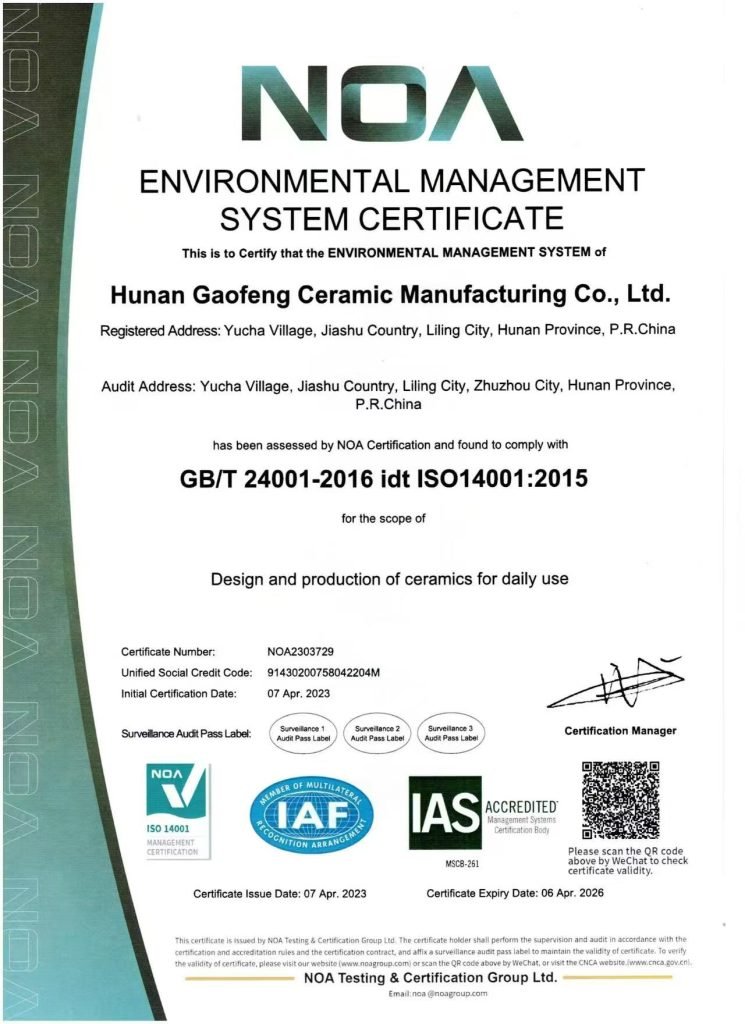
Most audit conversations begin in the wrong place. A sourcing team asks a prospective BSCI audit supplier for the certificate, receives a PDF with a summary page, and treats the onboarding question as closed. An audit does not certify a product. It describes how a site was managed during a defined window, and it says nothing about whether the glaze on your mug releases anything into a hot drink.
This article is for compliance and sourcing teams who have to read these documents and decide what they are worth. It separates three instruments that are routinely confused, sets out what each can and cannot evidence, and lists the files to request so that a social audit and a food-contact report are not merged into one folder labelled compliance.
Key takeaways
- Audits prove management, not product safety: BSCI and SMETA cover labour and site conditions, while glaze and decoration chemistry sits in a separate file.
- Three instruments, three questions: BSCI is a social audit programme, Sedex is a data platform, Higg FEM is an environmental assessment.
- No audit report is a food-contact test; ask for FDA or LFGB test reports for the body and decoration separately.
- Check scope before summary: site name, audit date, audit method and any open corrective action.
- Build one pack of five or six documents and confirm the buyer’s acceptance rules in writing, because validity is set by the scheme and the retailer.
1. Three instruments, three different questions
At a glance: BSCI, Sedex and Higg FEM answer different questions about a factory, and treating them as interchangeable certificates is where onboarding packs fail.
A social audit asks whether people are managed lawfully and safely. A data platform asks how that evidence is stored and shared. An environmental assessment asks how the site manages energy, water and waste. None of them asks whether a mug is safe to drink from, and none of them is a product certificate. A buyer who expects one document to cover all four questions will either pay twice for the same evidence or miss the file the retailer actually requires.
| Instrument | What it assesses | Output you receive | Who typically asks |
|---|---|---|---|
| amfori BSCI | Labour, wages, hours, health and safety, basic environment | Report with findings and a rating under the amfori scheme | Retailers and brands using amfori |
| Sedex / SMETA | Labour, health and safety, environment, business ethics | Audit report uploaded and visible to linked customers | UK and EU retailers, distributors |
| Higg FEM | Facility energy, water, waste and emissions | Self-assessment, verified where claimed | Brands with environmental programmes |
| ISO 9001 and 22000 | Quality and food-safety management systems | Certificate issued by a certification body | Retail onboarding, food-sector buyers |
The practical test is simple. Before reading a rating, ask what the instrument assesses, who accepts it, and whether the BSCI audit supplier can name the site that will make your order. A report that satisfies a clothing retailer may be irrelevant to a European distributor asking about food contact, and a food-contact report will say nothing about working hours.
2. What an amfori BSCI audit actually assesses
At a glance: a BSCI audit examines a site’s labour and health-and-safety management against the amfori code, and produces findings rather than a product approval.
The audit is conducted against the amfori BSCI code of conduct and covers working hours, wages, child and forced labour, freedom of association, health and safety, and basic environmental practice. The output is a report with findings and a rating produced under the amfori scheme. Two details matter more than the headline: the site named in the report must be the site that will make your mugs, and any open corrective action is part of the result rather than an appendix.
MugFactory can share BSCI documentation for review, and the BSCI download page is the shortest route to the file. Read it with the site name and audit date in front of you, not as a logo to place on a supplier scorecard.
3. Sedex is a platform, and SMETA is the audit
At a glance: Sedex stores and shares audit and responsible-sourcing data, and the audit method most buyers recognise inside it is SMETA.
Sedex is a membership platform where suppliers upload audit reports and buyers view the sites they are linked to. SMETA is one of the methodologies whose reports are shared through it, covering labour standards, health and safety, environment and business ethics. The distinction matters commercially: being on Sedex means your data is visible to a customer, while holding an audit means a site was assessed on a date against a defined method and scope.
Our Sedex download page follows the same request route as the BSCI file. When a customer asks whether you are on Sedex, answer with the platform link and the audit it contains, because one without the other is only half an answer.
4. Higg FEM measures environmental management
At a glance: Higg FEM is a facility-level environmental assessment covering energy, water, waste and emissions, not a labour or product-safety instrument.
The Higg Facility Environmental Module is completed as a self-assessment and can be verified by an approved verifier. It produces a picture of how a site manages environmental performance, which is useful for a brand with science-based targets and largely silent on working conditions and on what a mug releases when it meets hot coffee. A verified module is stronger evidence than an unverified one, and the version and scope should be quoted whenever a score is discussed.
Our Higg FEM self-assessment is available on request, and the wider environmental work sits with the commitments described on our sustainability page. Neither replaces a laboratory report on glaze chemistry.
5. What no social or environmental audit can prove
At a glance: no factory audit can prove that a specific mug is food-contact safe, that a batch matched its sample, or that conditions held on the days your order ran.
This is the boundary buyers most often miss. An audit samples a management system during a window; a production order runs for weeks afterwards, possibly across several lines and shifts. The auditor may not test glaze chemistry, and even a well-run factory can ship a batch with a shifted print if no master sample was approved. Compliance is a set of files that answer different questions, not one certificate that answers all of them.
| Question | What the audits cover | What actually answers it |
|---|---|---|
| Is the glaze safe for food contact? | Not assessed by any of the three | Test report for the body and decoration |
| Is this batch the same as the sample? | Not assessed | Approved master sample and in-process checks |
| Were conditions compliant on your production days? | A window around the audit date | Audit evidence plus your own follow-up questions |
| Is the mug itself environmentally preferable? | Facility data, not product data | Verified figures and careful claim wording |
| Is the product legal in your market? | A management framework only | Your compliance team and market-specific testing |

6. Food contact is a separate evidence file
At a glance: food-contact compliance for ceramic mugs is evidenced by test reports on the body and decoration, not by a social audit or a management certificate.
For ceramic ware the relevant evidence is a report from an accredited laboratory, produced against the standard your destination market applies. In the United States that conversation usually runs through FDA food-contact requirements; in the European Union and Germany, through the framework regulation and LFGB. Applicable limits depend on the market and on how the article is used, so confirm them with your laboratory rather than with a supplier summary.
Reports are issued for a specific body and decoration, which is why a report for a plain white mug does not automatically cover a gold-rimmed version. The care instructions you give customers belong to the same file: a metallic rim that cannot go in a microwave needs clear wording, and our mug care guide sets out what to tell buyers. This article is general information, not legal advice. Confirm the applicable standard with your compliance team or lab.
7. Assembling a document pack that survives onboarding
At a glance: a complete pack answers management, environment, quality, food contact and traceability in five or six files, each tied to a named site and date.
Retail onboarding usually stalls on a missing file rather than a failed audit. Build the pack once, keep the versions under control, and check that every document names the same legal entity and site that will appear on the commercial invoice. Where a document is issued for a group rather than a site, ask for the scope page that shows which factory was assessed. Our compliance and food contact articles look at test standards and claim wording in more depth. A BSCI audit supplier that cannot show the site name on the report has given you a logo, not evidence.
| Document | What it evidences | Who issues it | Question it answers |
|---|---|---|---|
| Social audit report | Site labour and safety management | Audit firm under the scheme | Can we onboard this site? |
| Higg FEM module | Facility environmental performance | Site, verified where claimed | What is the environmental baseline? |
| ISO 9001 certificate | Process control and corrective action | Certification body | Is there a documented QC system? |
| ISO 22000 certificate | Food-safety management | Certification body | How is hygiene controlled? |
| FDA or LFGB report | Migration from glaze and decoration | Accredited laboratory | Is this article suitable for food contact? |
| Traceability and photo QC | That the shipped batch matched the sample | The factory | Did this order match the sample? |
Five checks separate a pack from a pile of PDFs:
- Match the site name and address to the factory that will produce the order.
- Record the audit date and any open corrective action, not just the summary line.
- Tie the food-contact report to the body, glaze and decoration you are buying.
- Keep the exact version you sent to the retailer, so a later update can be explained.
- Confirm the buyer’s acceptance rules in writing, because each programme sets its own.
8. How MugFactory de-risks the document pack
MugFactory is a vertical full-stack custom mug company: ceramic, bone china and stoneware mugs made on our exclusive Liling lines, with design, packaging, QA, export documents and after-sales handled by one in-house team. Since 1994 the site has grown into six production bases, ten branch factories and twenty kilns producing up to 100 million pieces a year for customers in more than 40 countries.
- Audit and certification documents, including BSCI, Sedex, Higg FEM, FSC and ISO 22000, released on request rather than described in marketing copy.
- Food-contact test reports for glaze and decoration available for review, tested to FDA or LFGB requirements rather than described as certified.
- Batch traceability records and a photo QC report for each shipment, so a document pack ties to a specific order.
- One in-house team for design, packaging, QA and export documents, which means one contact for onboarding paperwork.
- Twenty kilns across six production bases and ten branch factories, so capacity and documentation sit with the same organisation.
The Liling mug factory page shows the plant and the inspection stations behind those records, from material verification through to the final drop test.
Collect the documents before you commit
Tell us the destination market, the retailer’s onboarding list and the body you are considering. We will send the audit and test documents we hold for that specification, with the site names and dates visible.
FAQ
What is a BSCI audit?
It is a social audit against the amfori BSCI code of conduct, covering labour practices, working hours, wages, health and safety and basic environmental requirements at a named site. The output is a report with findings and a rating produced under the amfori scheme. Read the site name, the audit date and any open corrective action before the summary page.
What is the difference between BSCI and Sedex?
BSCI is an audit programme and code of conduct run by amfori. Sedex is a platform where suppliers store and share audit and responsible-sourcing data with customers, and SMETA is a common audit method whose reports are shared there. A factory can hold a BSCI audit without being on Sedex, or sit on Sedex with a different audit format.
What does a Higg FEM score mean?
It is a facility-level environmental score derived from the Higg Facility Environmental Module, covering energy, water, waste and emissions management. It can be self-assessed or verified by an approved verifier. The score says nothing about labour conditions or food-contact safety, and comparisons only make sense where the module, version and verification status match.
Does an audit replace food-contact testing?
No. Social and environmental audits examine how a site is managed. Food-contact safety depends on the glaze, decoration and firing of a specific article, and is evidenced by a laboratory report against the standard your market applies. Ask for the report that covers the exact body, glaze and decoration you are buying, not the one attached to a different product.
How long is an audit report valid?
There is no single validity period. amfori BSCI, Sedex and Higg each set their own review and refresh cycles, and most retailers add an acceptance window of their own on top. Treat a report as evidence of a period rather than a permanent status, check the date and the site, and confirm the buyer’s requirement in writing.
Sources

MugFactory’s sourcing and production team helps brands, retailers and distributors plan custom ceramic mug programs from 500-piece pilots to annual production. Based in Liling, close to the lines, the team covers design, packaging, QA, export documents and after-sales.

