

“What does a custom mug cost?” is the wrong first question. A mug has a body, a decoration, a package and a route to your warehouse; each of those changes the number. Buyers who compare only the unit price often choose the quote that is cheapest on paper and most expensive after freight, duty, reprints and breakage.
This guide breaks down MugFactory’s 2026 tier pricing, the six variables that move the number, the difference between FOB and landed cost, and the questions to ask before you approve a quote. All prices are indicative and confirmed against a final specification.
Key takeaways
- Unit price = body + decoration + packaging + setup amortisation + freight/duty. No single number covers all five.
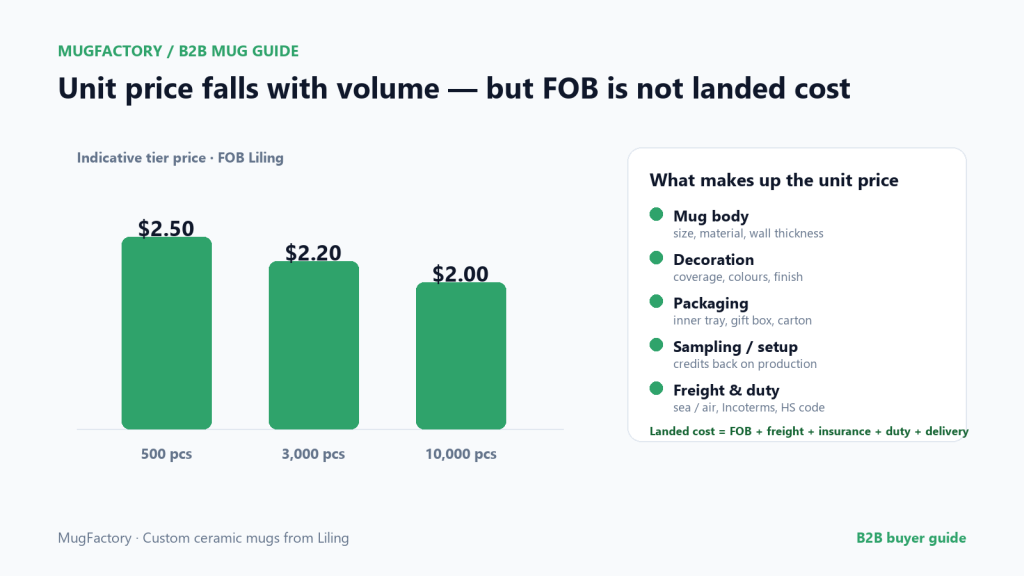
- Indicative tiers: from $2.50 at 500 pcs, $2.20 at 3,000 pcs and $2.00 at 10,000 pcs, FOB Liling, standard body and one decoration.
- FOB is not landed cost. Add freight, insurance, duty, brokerage and delivery before comparing suppliers.
- 500 pcs is the standard MOQ. Mixed designs can share a run; new moulds or premium finishes are quoted separately.
- The cheapest quote is often the one with the most exclusions. Compare specification and Incoterms line by line.
The price formula
At a glance: build the price from five layers — body, decoration, packaging, setup and delivery — and compare quotes on the same layers.
A custom mug quotation is a stack, not a single rate. The body includes the clay, forming, glazing and firing. The decoration includes the process, number of colours, coverage and any additional firing. Packaging includes the inner tray, gift box, sleeve, carton and labels. Setup includes the sample, screens, decals or mould amortisation. Delivery includes freight, insurance, duty and local transport.
| Cost layer | What it includes | Typical effect on unit price | How to control it |
|---|---|---|---|
| Body | Clay, forming, glaze, firing, handle attachment | Largest single component | Standard body, shared sizes, volume tier |
| Decoration | Decal, sublimation, screen print, relief, gold rim | Second-largest; can exceed body | Limit colours/coverage; choose the right process |
| Packaging | Inner tray, gift box, sleeve, carton, label | Can be 5–25% of unit cost | Standard carton; upgrade only where it sells |
| Setup | Sample, screens, decals, mould, artwork proof | Fixed per design; amortised over quantity | Fewer designs; approve before production |
| Delivery | Freight, insurance, duty, brokerage, delivery | Varies by mode and Incoterms | Sea freight, consolidated shipments, correct HS code |
Real tier prices for 2026
At a glance: volume lowers the unit price, but the step from 500 to 10,000 is roughly 20%, not 80%; the remaining cost is materials, decoration and packaging.
| Quantity | Indicative unit price (FOB Liling) | Included in the reference price | Not included |
|---|---|---|---|
| 500 pcs | from $2.50 | Standard 11oz ceramic body, one decoration, standard packaging | Gift box, multi-colour print, testing, freight, duty |
| 3,000 pcs | from $2.20 | Same specification; setup amortised across the run | Custom mould, premium finish, split shipments |
| 10,000 pcs | from $2.00 | Same specification; planned production slot | New body, special packaging, expedited freight |
These are reference prices, not a public price list for every mug. A 15oz stoneware body with a gold rim and a rigid gift box is not the same product as an 11oz ceramic mug with a one-colour print. Use the tiers to size the budget, then ask for a specification-based quote.

Six variables that move the price
At a glance: size, material, decoration coverage, packaging, quantity and Incoterms explain almost every quote difference.
| Variable | What changes | Price direction | Buyer action |
|---|---|---|---|
| Size / capacity | 11oz vs 15oz vs 20oz; wall thickness | Larger body usually costs more | Confirm real fill volume first |
| Material | Ceramic vs stoneware vs bone china vs porcelain | Premium bodies cost more | Match material to positioning, not assumptions |
| Decoration | Number of colours, coverage, process | Full wrap and multi-colour rise faster | Reduce colours or coverage where possible |
| Packaging | Gift box, insert, sleeve, carton | Upgrades add cost and cube | Test a standard carton before upgrading |
| Quantity | 500 vs 3,000 vs 10,000 pcs | Unit price falls with volume | Consolidate designs and forecast annually |
| Incoterms / route | EXW, FOB, CIF, DDP; sea vs air | FOB excludes freight and duty | Compare total landed cost, not FOB only |
Sampling, setup and mould costs
At a glance: setup is a fixed cost per design or body; the more designs and custom parts, the more setup you amortise over the order.
A physical sample is a small production run: the body is made, decorated, fired and checked. MugFactory credits the sample fee against the first production order, so the sample is not an extra cost if the program proceeds. A digital mockup is used first to check artwork placement and packaging before a physical sample is committed.
A new body, handle or mould is a separate tooling project. It needs engineering review, a tooling quote and additional time before sampling. If you are testing a market, start with an existing body and spend the tooling budget on packaging or a second design instead. A custom mould only makes sense when the shape is a core part of the brand or when volume justifies the amortisation.
| Item | When it applies | How it is charged | What to confirm |
|---|---|---|---|
| Digital mockup | Before sampling | Usually included in the quote process | Print area, colours, packaging dieline |
| Physical sample | Before production | Sample fee, credited against the first order | Specification, decoration, packaging |
| Screen / decal setup | Per design and colour | Setup fee or amortised in unit price | Number of colours and artwork revisions |
| New body / mould | Custom shape or handle | Quoted separately | Tooling cost, sample time, ownership |
| Packaging die | Custom gift box or sleeve | Quoted separately | Dieline, material, minimum quantity |
Sea vs air freight
At a glance: sea freight is the default for production orders; air freight is a launch-protection tool, not a way to make a late order cheap.
| Mode | Transit time | Cost per kg | Best use |
|---|---|---|---|
| Sea freight | ~30 days port-to-port; 45–55 days door-to-door | Lowest | 500+ pcs, planned retail/wholesale |
| Air freight | 5–10 days airport-to-airport; 10–14 days door-to-door | 3–5× sea (indicative) | Short launches, samples, premium gift programs |
| Express | 3–7 days door-to-door | Highest | Samples, urgent top-ups, small orders |
Freight is charged on chargeable weight, not just actual weight. Ceramic mugs are dense and packaging adds volume, so a carton can be heavier than expected. Ask for the carton dimensions and gross weight before you compare freight quotes. A slightly higher FOB price with better carton optimisation can be cheaper landed.
Landed cost example
At a glance: a $2.50 FOB mug can land at roughly $3.70 per unit on a small sea shipment once freight, duty and delivery are included. The exact number depends on your route and HS code.
| Line | Calculation | Amount |
|---|---|---|
| FOB goods | 500 × $2.50 | $1,250.00 |
| Freight + insurance | Sea freight quote + insurance | $400.00 |
| Duty | 5% of customs value (illustrative) | $62.50 |
| Brokerage / customs fees | Fixed fee (illustrative) | $50.00 |
| Local delivery | Port to warehouse | $80.00 |
| Total landed | Sum of the above | $1,842.50 |
| Landed per mug | $1,842.50 ÷ 500 | $3.69 |
This example is deliberately simple. Duty rates vary by country, HS code and trade program; some markets apply anti-dumping or additional tariffs; freight rates move with season and fuel. Use the calculation to compare quotes on a like-for-like basis, then confirm the actual duty and freight with your broker.
Seven low-price traps
- EXW versus FOB. An EXW price excludes loading and export clearance; FOB includes them. The gap can be several percent.
- Print coverage. A one-colour logo and a full-wrap photo are not the same decoration cost, even if both are called “printing”.
- Packaging exclusions. A quote may exclude inner trays, gift boxes, labels or cartons; add them before comparing.
- Sample fees. A “free” sample may be offset by a higher unit price or a non-credited tooling charge.
- Off-spec bodies. A cheaper body may use a lower-grade glaze or thinner wall; ask for the specification and test reports.
- Freight assumptions. A low unit price with a bad carton or a distant port can lose money after freight.
- No written change process. If artwork changes after production starts, the cheapest quote can become the most expensive program.
How to get a costed quote in one hour
At a glance: the fastest quotes come from a complete brief, not from a long email thread. Send five things: use case, body/capacity, artwork status, quantity and destination.
MugFactory aims to return an initial quote within one hour during business hours when the brief is complete. The quote should show the body, decoration, packaging, Incoterms, sample fee and production window. If a line is missing, ask for it before comparing. The goal is not the lowest number; it is the lowest total cost for a specification that will sell.
How to compare two quotes line by line
At a glance: compare specification, quantity, Incoterm, packaging and payment terms on one sheet; a lower unit price with a weaker scope is not a lower cost.
Take two quotes and rewrite them into the same format. If one quote is FOB and the other is DDP, convert both to a landed basis. If one includes a gift box and the other does not, add the missing box. If one covers two print colours and the other covers four, the unit prices are not comparable.
| Line to compare | Question to ask | Why it matters |
|---|---|---|
| Body specification | Size, material, wall thickness, glaze | The cheapest body may not meet the brief |
| Decoration | Process, number of colours, coverage | Full wrap and spot colour have different setups |
| Packaging | Inner tray, gift box, carton, labels | Packaging can be 5–25% of unit cost |
| Quantity / tier | 500, 3,000 or 10,000; mixed designs | Tier pricing changes the unit price |
| Incoterm | EXW, FOB, CIF or DDP | Freight and duty may be excluded |
| Sample / tooling | Fee, credit, mould ownership | Setup may be hidden in the unit price |
| Payment terms | Deposit, balance, LC or TT | Cash flow is part of the total cost |
A cost-reduction plan that protects quality
At a glance: reduce cost by simplifying the specification and consolidating volume — not by accepting an unverified body or an unclear test report.
- Use a standard body. Keep the custom shape for the hero SKU and use an existing body for the rest of the range.
- Reduce decoration complexity. Fewer colours and a smaller print area can cut setup and unit cost without losing brand recognition.
- Consolidate designs. One 3,000-piece run across three designs is usually cheaper than three 1,000-piece runs.
- Right-size packaging. Use a standard carton for wholesale and reserve the rigid gift box for the premium SKU.
- Plan freight early. Sea freight with a full container is cheaper per unit than a late air shipment.
- Forecast annually. A committed annual volume can secure a better tier and a production slot.
The cheapest way to reduce cost is to remove rework: approve the artwork and sample before production, keep the specification stable, and place the order early enough to use sea freight. Those changes cost nothing and protect both the unit price and the launch date.
What a quote should include
At a glance: a useful quote is a specification document, not a single number; it should make the assumptions visible enough that two suppliers can be compared.
Ask for the body specification, decoration method, number of colours, packaging list, sample terms, Incoterm, production window and validity date. A quote that says only “$2.30/pc FOB” is not a quote; it is a starting point for assumptions.
If the supplier cannot explain the cost drivers, the lowest number is not a reliable number. A good quote should also say what is not included: freight, duty, testing, a gift box, a second design or storage. Those exclusions are where the budget usually breaks.
| Line | What to look for | Why it matters |
|---|---|---|
| Body | Size, material, wall thickness, glaze | Defines the product you are comparing |
| Decoration | Process, colours, coverage, firing | Explains the setup and durability |
| Packaging | Tray, box, carton, labels | Can change unit cost and freight |
| Sample | Fee, credit, approval step | Prevents production surprises |
| Incoterm | EXW, FOB, CIF or DDP | Changes who pays freight and duty |
| Lead time | Sample, production, transit | Makes the on-shelf date real |
| Validity | How long the price holds | Protects against material/freight moves |
Five questions to ask before accepting a price
At a glance: the price is only useful if you know what it covers, how long it holds and what happens when the specification changes.
- Is this FOB or DDP? Ask who pays freight, insurance, duty and the final delivery.
- How many print colours are included? A full-wrap print is not the same specification as one spot colour.
- What packaging is in the price? Confirm inner tray, gift box, carton and labels line by line.
- Is the sample fee credited? Ask when the credit applies and whether tooling is refundable.
- How long is the price valid? Material, energy and freight can move; a validity date protects both sides.
If a supplier cannot answer these five questions in writing, the unit price is not comparable. The same applies to a quote that excludes testing, a second design or storage. A good quote is a small contract, not a number in an email.
What changes on a repeat order
At a glance: a repeat order removes the tooling and artwork setup, so the price should improve even before the volume tier changes.
On a repeat order, the body, glaze, decoration and packaging are already approved. The remaining cost is production, materials and freight. That is why a second order can often move to a better tier or a shorter timeline than the first. Keep the approved sample, artwork files and packaging dieline on file so the reorder does not restart the learning curve.
If the design or packaging changes, treat the reorder as a new project. A new colour, a new box or a new body can invalidate the previous setup and bring back sample and tooling costs. Plan changes at least one production cycle ahead and confirm the price impact before the artwork is revised.
Need a costed mug quote?
Send the specification, quantity and destination. We will return an indicative tier price, the main cost drivers and the production calendar — with the assumptions written down.
FAQ
Why is my quote higher than the $2.50 tier?
The tier price is a reference for a standard 11oz ceramic body with one decoration and standard packaging, FOB Liling. A larger body, premium material, full-wrap print, gift box, testing or expedited freight adds cost. Ask for the line-by-line breakdown.
Is the sample fee refundable?
MugFactory credits the sample fee against the first production order. If the program does not proceed, the sample remains a standalone cost. Confirm the credit terms in the quote.
How much does a new mould cost?
A new body or handle is a separate tooling project, quoted after an engineering review. It adds time before sampling and is only worthwhile when the shape is central to the brand or the volume supports amortisation.
Is FOB or DDP better?
FOB gives you control over freight and is usually cheaper for experienced importers. DDP is simpler but the supplier builds freight, duty and risk into the price. Compare the landed cost, not the Incoterm label.
How much does sea freight add per mug?
It depends on volume, carton efficiency and route. For planning, sea freight is usually a small fraction of the unit cost on full containers, but on a 500-piece order the fixed costs are spread over fewer units. Ask for a door-to-door quote.
Can I get a lower price at 10,000 pcs?
Yes, volume lowers the unit price and allows a planned production slot. The exact price depends on the body, decoration and packaging. Share the annual forecast so we can propose a tiered program.
Sources

MugFactory’s sourcing and production team helps brands, retailers and distributors plan custom ceramic mug programs from 500-piece pilots to annual production. Based in Liling, close to the lines, the team covers design, packaging, QA, export documents and after-sales.


