
Most mug compliance conversations start in the wrong place. A buyer asks for one certificate that proves the mugs are fit for food contact, the supplier sends a social audit instead, and six weeks later the retail onboarding team is still waiting for the document that answers the question. The paperwork that usually answers it is a test report, and no other page in the pack replaces it. Before you request an LFGB ceramic mug report or a factory audit pack, separate the three document types, because each one proves a different thing.
This guide is for importers, distributors and retail compliance teams assembling a document pack for a custom mug order. By the end you should be able to name the seven documents most programs are asked for, say what each one proves and what it cannot prove, and judge whether a report is genuinely current or only looks current.
Key takeaways
- Three document types: an audit checks how a site works, a test report checks what a sample releases, a management-system certificate checks that a process is controlled.
- No FDA certificate exists for a mug. Compliance rests on testing glaze and decoration to FDA food-contact requirements and keeping the reports on request.
- One LFGB report can serve several EU buyers, but test conditions, decoration scope and the accepting lab matter more than the logo on the page.
- Reports are point-in-time. A new glaze, decal or kiln line resets the evidence, so agree a re-test trigger in writing.
- Seven downloads cover most packs, and they should be requested with the sample at 500 pcs, not after the purchase order.
1. Three document types, three different jobs
At a glance: an audit, a test report and a management-system certificate answer three different questions, and asking for one when a retailer wants another is the most common way a document pack stalls.
An audit inspects a site and its practices on a given date: how workers are contracted, how hours are recorded, how safety is managed. A test report takes a sample and measures what it releases under defined conditions, which for a mug means the glaze, the decoration and the rim. A management-system certificate confirms that a documented process exists and is reviewed periodically, and it is issued to the organisation rather than to a product. None of the three substitutes for another.
The three are complementary. A retailer onboarding a new supplier may ask for all three, and each lands in a different part of the file. The market detail behind each document sits in our compliance and food contact category.
| Document type | What it proves | Who issues it | What it does not prove | When it needs renewing |
|---|---|---|---|---|
| Audit report | How a site treats workers and manages social risk | Independent audit firm | Glaze, lead or food-contact migration | A new audit cycle or a change of site |
| Test report | What a named sample releases under stated conditions | Accredited laboratory | Labour practice, management systems or packaging | A new glaze, decal, body or kiln line |
| Management-system certificate | That a documented process is in place and audited | Certification body | The performance of one batch or one decoration | Expiry, or a change in certified scope |
2. The seven documents a mug program is actually asked for
At a glance: seven documents cover most mug requests, and only two of them describe what actually touches the drink.
A typical pack contains two food-contact test reports, one for the US market and one for the German and wider EU market; two social audits; one food-safety management-system certificate; one certificate for the paper packaging; and one facility environmental assessment. Retailers rarely ask for all seven at once, but they ask for more of them each year.
Ask for the full list at brief stage and say which market each document has to satisfy. A pack that answers the retailer’s matrix in one email saves a fortnight of questions.
| Document | What it proves | Who typically asks | How current it needs to be |
|---|---|---|---|
| FDA food-contact test report | Migration from glaze and decoration against FDA requirements | US importers, retail compliance, marketplace sellers | Matches the body and decoration shipped |
| LFGB test report | Migration against German LFGB expectations, widely used across the EU | EU importers, German retailers, discount chains | Matches the body and decoration shipped |
| BSCI audit report | Social performance of the production site | EU and UK retailers, sourcing teams | Latest audit cycle, with corrective actions closed |
| Sedex records | Shared audit and site data on one platform | UK retailers, buyers already on Sedex | Latest social audit shared on the platform |
| ISO 22000 certificate | A food-safety management system is in place and audited | Retail compliance, food-service buyers | Valid certificate with the site named in scope |
| FSC certificate | Paper in cartons and inserts comes from certified sources | Retail packaging teams, sustainability questionnaires | Valid certificate with the product scope listed |
Currency is where packs fail quietly. A report carries an issue date, a sample description and a set of test conditions. When the glaze, the decoration supplier, the body or the kiln line changes, the evidence no longer describes what you are buying. Ask when the report was issued, which decoration it covers and whether the laboratory is accredited for the method.

3. There is no certificate a factory can hold for food safety
At a glance: US food-contact rules are built around substances and test data rather than factory badges, so the honest answer to a safety questionnaire is a report and a declaration.
The FDA regulates food-contact substances and publishes guidance for ceramicware, including CPG Sec. 545.450 on lead contamination in pottery. That guidance describes what the agency looks at when it examines glazed ceramicware; it does not create a factory-level certificate. A mug is supported by test data on the fired glaze and decoration, by a supplier declaration, and by traceability that ties a batch to that data.
That is why a straight answer sounds less impressive than a logo. We test glaze and decoration to FDA food-contact requirements and provide reports on request, and there is no certificate to frame. Food contact is also only one claim on the pack: durability is tested separately, and our guide to dishwasher and microwave safety covers the care side.
4. What an LFGB ceramic mug report actually covers
At a glance: an LFGB ceramic mug report describes migration from a named body, glaze and decoration under stated conditions, so the scope paragraph matters as much as the result.
In the EU, Regulation (EC) No 1935/2004 sets the framework for food-contact materials: they must not transfer constituents in quantities that endanger health, and they must be labelled and traceable. Germany’s LFGB adds national requirements that many European retailers treat as the working benchmark. A test report should name the sample, the decoration, the simulant, the temperature, the contact time and the laboratory that ran it.
Read the scope before the conclusion. A report issued for a plain white body does not cover a gold-rimmed version with a full-wrap decal, even when both come off the same line. Ask for a declaration of compliance that links the report to the specification you are ordering. Regulation and enforcement differ by country and change over time; this article is general information, not legal advice. Confirm the applicable standard with your compliance team or lab.
5. BSCI and Sedex answer a social question
At a glance: BSCI and Sedex describe how a site treats people and manages social risk; they say nothing about lead migration from a glaze.
amfori BSCI is a social audit program: an auditor visits the site, reviews records and interviews workers, then grades performance against a common framework. Sedex is a platform where suppliers share audit and site data with several customers at once, which reduces the number of duplicate audits a factory hosts. Retail buyers use both for onboarding and for their own supply-chain reporting.
Both documents can be reviewed before a sample is cut, and sending them early usually clears the first onboarding stage. You can read our BSCI audit report and our Sedex records alongside the technical file, but keep food-contact evidence in a separate part of your matrix so the two are never confused.
6. Management systems and factory evidence
At a glance: ISO 22000 certifies a food-safety management system at an organisation, not the migration performance of a batch, and treating it as a product test misses the point twice.
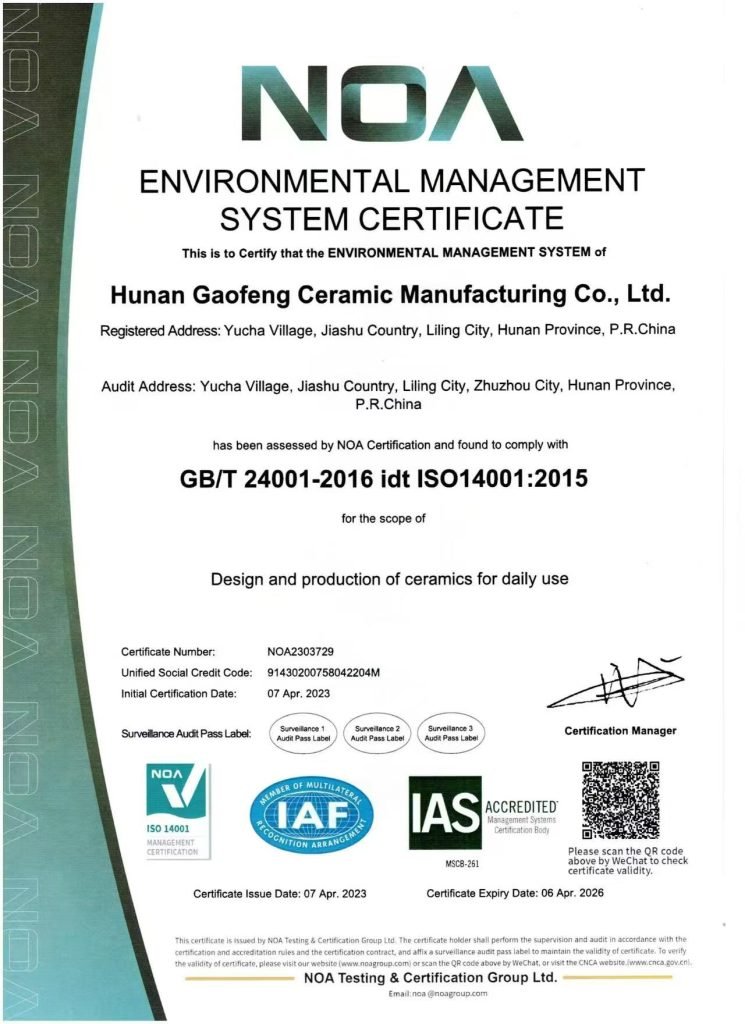
ISO 22000 sets requirements for a food-safety management system, including hazard analysis and prerequisite programs; ISO 9001 covers quality management more broadly, and an environmental management certificate follows the same logic for environmental performance. What a buyer can check is the certificate number, the certification body, the scope statement and the expiry date, and whether the scope names the site that will make the mugs.
A certificate never closes a food-contact question on its own. Our environmental management system certificate is published as a PDF for exactly this check, and the Liling factory page describes the inspection stages that sit under it.
7. Packaging and environmental data: FSC and Higg FEM
At a glance: FSC covers the paper in the box and Higg FEM covers environmental performance at the site; neither one makes a ceramic mug itself environmentally preferable.
FSC chain-of-custody certification traces certified material from forest to printed carton, so the certificate should list a product scope and a code a buyer can verify. Higg FEM is a facility-level self-assessment of environmental performance, used by brands to compare sites and to answer retail questionnaires. It is a management tool rather than a product claim, and both documents are regularly stretched past what they actually cover.
If packaging statements are going on the box, the paper evidence sits with our FSC certificate and the facility data with our Higg FEM self-assessment. Our sustainability page sets out which statements we will support with documents and which we decline to make.
8. Match the pack to the market, and keep it current
At a glance: the same mug needs a different pack for the US, the EU, the UK and Canada, and the pack expires faster than most buying calendars assume.
| Market | Food-contact evidence normally requested | Social and environmental evidence | Who normally checks it |
|---|---|---|---|
| United States | Test report against FDA requirements plus a supplier declaration | Social audit and factory profile | Importer, retail compliance, marketplace |
| European Union | LFGB or equivalent migration report plus a declaration of compliance | BSCI or Sedex and ISO 22000 | Importer and retail quality team |
| United Kingdom | Migration report accepted by the retailer plus a declaration | BSCI or Sedex, with FSC for packaging | Importer and retail technical team |
| Canada | Migration report plus a supplier declaration | Social audit, with FSC for packaging | Importer and retail compliance |
Two habits keep a pack usable. Keep one matrix that maps each market to the document that satisfies it, and put the issue date in every file name. When a retailer asks for a renewal, the matrix shows which documents are affected and which are untouched.
- Asking for a food-safety certificate when the market expects a test report.
- Accepting a report that does not name the decoration you ordered.
- Filing a social audit as evidence of food-contact safety.
- Sending a certificate whose scope does not name the production site.
- Starting the document request after the purchase order, when the sample is already approved.
How MugFactory de-risks the document pack
MugFactory produces ceramic, bone china and stoneware mugs on our exclusive Liling lines, with design, packaging, QA and export documentation handled by one in-house team. Since 1994 the Liling factory has supplied export markets, and the network now covers six production bases, ten branch factories and twenty kilns. The document pack follows the production process, which is why the reports describe the batch that ships.
- Material verification and master-sample approval before production is scheduled, so the report you accept describes the body and decoration that ships.
- Colour difference measured with a colour-difference meter and print position checked against the approved sample, logged per batch with the kiln records.
- Final inspection covering dimensions, handle strength, drop test, food-contact report and a photo QC report before shipment.
- Glaze and decoration tested to FDA and LFGB food-contact requirements, with reports available on request rather than promised as a badge.
- Two sustainability statements are published for review: the statement of intent for sustainable development cooperation and the sustainable development plan.
Collect the documents before you commit
Send the destination market, the decoration and the volume, and we will list the documents that apply before a sample is cut. Your compliance team can review the test reports and audit files first.
FAQ
Is there such a thing as FDA certification for mugs?
No. The FDA regulates food-contact substances and publishes guidance on ceramicware, including lead contamination in pottery, but it does not issue a certificate to a mug factory. What you can hold is a test report on the fired glaze and decoration, a supplier declaration and batch traceability. Ask for those three, and ask which sample the report describes.
What is the difference between LFGB and FDA testing?
Both measure what a glaze and decoration release, but they follow different frameworks and test conditions. FDA work is judged against US food-contact requirements; LFGB reflects German law and is widely accepted across the EU. A report written for one market does not automatically satisfy the other, so confirm which standard your buyer’s matrix names before you pay for testing.
How long do food-contact test reports stay valid?
There is no fixed expiry date. A report describes a sample tested on a specific date, so it stays useful while the body, glaze, decoration and production line stay the same. Retail buyers often ask for recent evidence and for the scope to match the order. Agree a re-test trigger in writing, such as a new decal supplier or a kiln change.
Can I review a BSCI or Sedex report before ordering?
Yes. Both can be reviewed before a sample is made, and sending them early usually clears the first onboarding stage. Read the audit date, the site name and any open corrective actions rather than the grade alone. A current social audit is a condition of doing business for many retailers, but it is not a substitute for product testing.
Does a BSCI audit cover food contact?
No. BSCI assesses social performance: working hours, wages, contracts, health and safety, and management practice. It says nothing about lead or cadmium migration from a glaze. Food-contact evidence comes from a laboratory test report on the fired body and decoration, which sits in a different part of the supplier file.
Is ISO 22000 the same as HACCP?
No. HACCP is a hazard-analysis method; ISO 22000 is a management-system standard that requires hazard analysis, prerequisite programs and continual improvement, and it is audited by a certification body. A factory can run HACCP without being certified to ISO 22000. Check the certificate scope and expiry, and keep product test reports separate.
Sources
- FDA — CPG Sec. 545.450 Pottery (Ceramics): Lead Contamination
- FDA — Packaging & Food Contact Substances
- EUR-Lex — Regulation (EC) No 1935/2004 on food contact materials
- LFGB — German Food, Feed and Consumer Protection Code
- amfori — BSCI
- Sedex — Sustainable supply chain
- Higg — Higg Index / FEM
- ISO — ISO 22000:2018 Food safety management

MugFactory’s sourcing and production team helps brands, retailers and distributors plan custom ceramic mug programs from 500-piece pilots to annual production. Based in Liling, close to the lines, the team covers design, packaging, QA, export documents and after-sales.


