
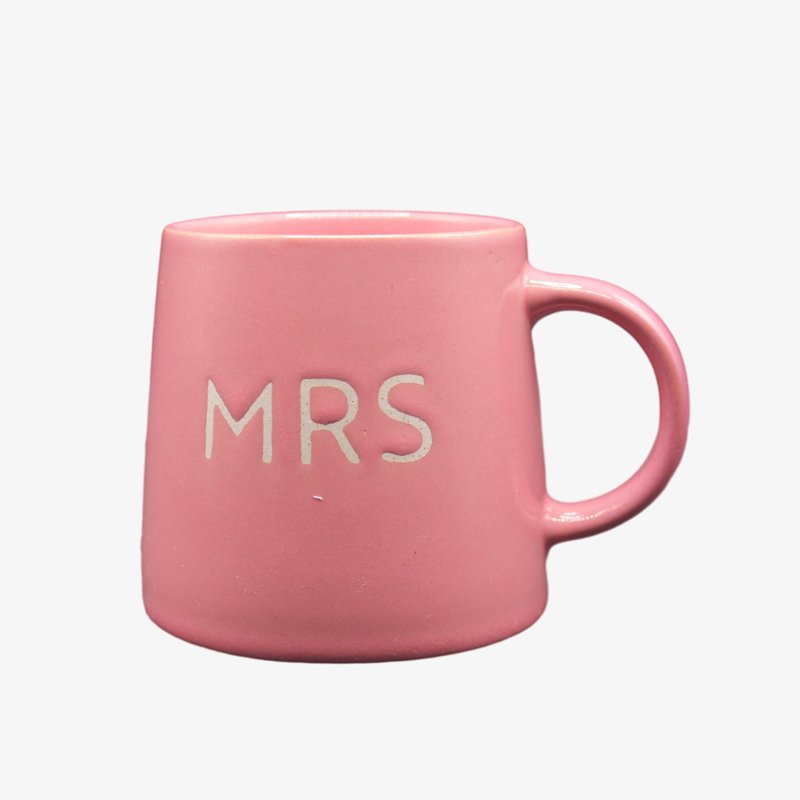
Favour guides usually start with the design: a motif, a palette, a date in a script font. The orders that go wrong rarely fail on design. Wedding mug favours fail on quantity, on boxes that arrive flat-packed on the morning of the setup, or on 140 names that turn out to be 140 print set-ups nobody costed.
This guide is for wedding planners, stationers and couples buying wedding mug favours in bulk, and for venues repeating the exercise for anniversaries. It covers the format decision, the personalisation trade-offs, gift-ready packaging and a calendar counted back from the date.
Whether you order wedding mug favours bulk or table by table, the decisions below decide the outcome.Key takeaways
- A favour is a table object first: settle format, size and number per table before artwork.
- Standard bodies start at 500 pieces per design; mixed designs can share a run and samples can go below it.
- One shared design is a print job; a name on every mug is an artwork per name.
- Samples take 7–10 days after artwork approval, production 30–45 days, sea freight about 30 days.
- The gift box changes cost, carton volume and assembly time, so decide it before the mug.
1. Start from the table, not the design
At a glance: how the favour is given out decides the body, the box and the quantity, long before a colour is chosen.
A favour placed at each setting is handled by the venue, must stand upright and usually needs a name card. One handed out at the door travels home in a bag. One that doubles as a seat marker must be readable across the table. Those are three products.
Count from the seating plan, not the guest list. Tables of eight or ten pack easily, and a spare allowance of roughly 5–10 per cent is common for breakage, late guests and the photographer’s table. Treat that allowance as your own assumption and budget for it.
Anniversary mug favours follow the same logic with less slack: a smaller list, a date tied to a family event, and usually a pair per couple — one to give, one to keep. That changes quantity more than design. Our wedding mug and anniversary mug ranges show the formats normally used.
2. Match the format to the table and the budget
At a glance: a smaller body keeps the favour in proportion on a crowded table; a larger mug reads as a gift and costs more to ship.
For a place setting, an espresso cup or a small mug is enough: it holds a coffee at the end of the meal without crowding the cutlery. For an exit favour, an 11 oz / 330 ml mug is the object guests use at home. A gift set belongs with the wedding party, not with every guest.
| Format | Typical capacity | Best moment | Cost tier | Packaging |
|---|---|---|---|---|
| Espresso cup and saucer | 3–6 oz / 90–180 ml | Place setting | Entry | Small box or sleeve |
| Small mug | 8 oz / 240 ml | Place setting or exit table | Entry to mid | Sleeve, kraft box |
| Classic mug | 11 oz / 330 ml | Exit favour, gifting station | Mid | Gift box or printed sleeve |
| Bone china cup | 6–8 oz / 180–240 ml | Premium place setting | High | Rigid box with insert |
| Mug gift set | Two mugs, or mug with lid | Wedding party, parents | High | Rigid box with pulp insert |
Bone china is lighter in the hand and reads as more formal, which suits a black-tie table. Bone china mugs also need better packaging, because a thin wall does not forgive a loose carton. Formats are grouped by event in the occasion collection.
If the venue already sells house mugs, the favour can sometimes ride on that café program replenishment, which settles the packaging question early.
3. Decide personalisation before you price
At a glance: one shared design is a print job; a different name on every mug is a data, artwork and set-up project.
Decide what varies — the design, the date, the guest name, or nothing — then count the variants. One design across 200 guests is one artwork and one set-up. Two hundred names is two hundred artworks, each needing approval, and the decoration step becomes a sequence.
Per-name decals are the usual request and the usual surprise. A decal is printed on a film, applied to the glaze and fired in, so a new name means a new film and a new set-up. That is why per-name minimums appear, why the artwork cut-off moves earlier, and why the price per name falls more slowly than the price per mug.
Three ways to keep the personal touch without 200 set-ups: print one design and personalise the box with a name card, use a monogram or table number, or reserve per-name mugs for the head table and the wedding party.
| Method | What varies | Artwork and set-up | Durability | Practical note |
|---|---|---|---|---|
| One-colour screen print | Nothing per guest | One screen per colour | Good with the correct glaze and firing | Lowest set-up at volume; bold graphics only |
| Full-colour decal | Nothing per guest | One decal artwork, colour matched | Fired into the glaze | Best for detailed motifs and photographs |
| Per-name decal | Name on every mug | One artwork and one film per name | As above | Confirm the per-name minimum and cut-off |
| Laser engraving | Name or date | A file per name, no ink | Permanent mark; contrast depends on the glaze | Check the mark on a sample first |
| Gold rim or metallic | Nothing per guest | Extra process and stricter checks | Hand wash; not microwave safe | Label the care instruction on the card |
Ask to see personalisation on a physical sample, not a screen proof. A mockup shows placement and scale; it does not show how a thin script behaves on a curved wall.

4. Make the packaging gift-ready at the table
At a glance: a guest opens the box in front of other guests, so the packaging carries as much of the impression as the mug.
There are three practical levels. A printed sleeve is lightest: it protects the glaze, carries the date or the names, and packs flat. A folding carton with an insert holds the mug steady and looks finished on a table. A rigid gift box suits the wedding party and adds the most carton volume and assembly time. A two-piece gift set often solves the fitting problem first.
Decide who assembles. If the venue team is setting 20 tables on a Friday morning, a box that needs folding, inserting and ribboning is a staffing decision. Ask for packed carton dimensions and favours per carton before you approve: freight follows the carton, not the mug.
Paper claims need the same care as mug claims. FSC-certified board is available for boxes and inserts, and the certificate covers the paper, not the mug; recycled content and compostability claims need third-party evidence. More detail sits in our branding and presentation column.
5. Work back from the wedding date
At a glance: the date is fixed and the production calendar is not, so the order date is a calculation rather than a preference.
Three intervals set the calendar: a sample after artwork approval, production after sample approval, and freight after dispatch. Sampling is the step couples underestimate, because a mockup can arrive within the hour and a physical sample cannot. Add your own approval loop and a few days for corrections.
Peak season matters. From August to November, capacity fills with holiday programs, so a September or October wedding competes with Christmas production. A spring date has more room, but the lines run retail work all year.
| Weeks before the date | What happens | Allow |
|---|---|---|
| 16–14 | Brief, artwork, digital mockup, purchase order and deposit | Mockup within one hour of a complete brief |
| 14–12 | Physical sample made, shipped and approved | 7–10 days plus transit |
| 12–7 | Production run | 30–45 days after approval |
| 7–3 | Sea freight and customs clearance | About 30 days, varies by port and season |
| 3–0 | Delivery to venue, assembly, name cards | Buffer for the unexpected |
Start closer than about 12 weeks and the sample and the production run have to overlap, with air freight the only way to hold the date. Confirm both in the quote.
6. Budget the favour, not just the mug
At a glance: published tier prices cover the mug, one print position and standard export packaging; favours add boxes, names and freight on top.
Our indicative tiers for a standard 11 oz / 330 ml ceramic mug start at $2.50 at 500 pieces, $2.20 at 3,000 and $2.00 at 10,000, FOB Liling, including one print position and standard export packaging. Freight, duties, tooling and lab testing are quoted separately.
As an illustrative assumption, not a quote: a 140-guest wedding that orders 500 pieces at the entry tier of from $2.50 has roughly $1,250 of goods value before freight, with 360 mugs left over. Plan the spares — rehearsal dinner, venue tables, the anniversary next year — or the allowance becomes waste.
If the count is far below 500, mixed designs across two events can share a run, and a sample-level order can cover a small wedding. Ask for the quotation to show packaging and personalisation as separate lines.
How MugFactory de-risks a favour order
MugFactory produces ceramic, bone china and stoneware mugs on exclusive Liling lines, and the same sample room and QC gates handle a 500-piece favour order and an annual retail program. Design, packaging, QA and export documents sit with one in-house team, so the box, the name card and the carton are settled with the people who sign off the mug.
- A digital mockup within one hour of a complete brief, before a sample is made.
- Physical samples in 7–10 days after artwork approval, with the sample cost credited against the order.
- A Launch Kit from 500 pieces: product photos, a spec sheet and print-ready dielines, with two rounds of revisions.
- Mixed designs can share a production run, keeping a two-event order on one schedule.
- A photo QC report before shipment and a 24-hour response.
Test the body and the finish first
Before you commit 200 favours, hold the body: weight, handle, glaze and the way a name reads at table distance. We sample favour orders against the same standard as a retail program.
FAQ
What is the minimum for wedding favours?
For wedding mug favours, our standard MOQ is 500 pieces per design on standard bodies. Several designs can share one production run, and a sample-level order can go below the production minimum. Custom shapes, bone china and large decal programs may require a higher minimum, so confirm the figure in your quote.
Can every mug carry a different name?
Yes, with a process change. Each name needs its own decal artwork and film, so the per-name minimum, the artwork cut-off and the price all differ from a single shared print. If the budget is tight, print one design and personalise the box with a name card instead.
How far ahead should we order?
Aim for 16 weeks before the date. That covers a sample in 7–10 days after artwork approval, production in 30–45 days, and about 30 days of sea freight, with room for approvals. From August to November, holiday programs fill capacity, so add a buffer.
Can we mix two or three designs in one order?
Yes, on the same body and colour family. Mixed designs share a production run, but each design keeps its own decoration set-up and packaging specification, so the per-design minimum is confirmed in the quote. Mixing bodies as well as designs costs more, because the line has to change over.
What gift box works for a table favour?
For a laid table, a printed sleeve or a folding carton with an insert is the best balance of look and assembly time. Rigid boxes suit the wedding party. Ask for packed carton dimensions and pieces per carton, and confirm who assembles.
Sources

MugFactory’s sourcing and production team helps brands, retailers and distributors plan custom ceramic mug programs from 500-piece pilots to annual production. Based in Liling, close to the lines, the team covers design, packaging, QA, export documents and after-sales.


