

Most custom mug lead-time guides start with the factory’s production window and add shipping at the end. That order hides the two stages where dates actually move: artwork approval and the capacity queue. A custom mug lead time is not one number but four clocks — sampling, scheduling, production and freight — and a different party controls each one.
This guide is for brand owners, retail buyers and distributors working back from a fixed shelf date. Read it and you can build a timeline from brief to arrival, name the stage most likely to move, and set an order-by date that survives one artwork revision.
Key takeaways
- Production is 30–45 days after artwork and sample approval, and the clock starts on approval, not on the purchase order.
- Physical samples take 7–10 days after artwork approval; the sample fee is credited against the production order.
- Sea freight adds about 30 days port to port, and varies by port and season.
- Peak season is August to November. Capacity fills first in that window, so holiday programs are booked before it opens.
- Work back from the warehouse date. A 1 December shelf date needs artwork approved in late August on a standard program.
1. Why 30–45 days is not the lead time
At a glance: the production window starts after artwork and sample approval, so the first weeks of a project pass before a line is booked.
A quotation describes production, the part the factory controls directly. It excludes your mockup approval, the 7–10 days to make and ship a physical sample, and the queue that builds when several programs share the same kilns. Table 1 sets out the chain for a standard 11 oz / 330 ml mug with one decoration.
| Stage | What happens | Typical duration | Controlled by |
|---|---|---|---|
| Brief and mockup | Spec check, artwork on the dieline, mockup issued | Within 1 hour of a complete brief | MugFactory design team |
| Artwork approval | Colour references, print position, file format signed off | 1–5 days | You |
| Physical sample | Decorated, fired and checked against approved artwork | 7–10 days after artwork approval | Sample room |
| Production | Forming, glazing, printing, firing, in-process checks | 30–45 days after artwork and sample approval | Production |
| Sea freight | Port-to-port transit, then customs clearance | About 30 days, varies by port and season | Forwarder and carrier |
Most lost time sits in the request. A brief naming body, capacity, decoration, packaging, quantity and shelf date can be quoted and mocked up the same day; a request for a branded mug costs a week. Our RFQ template lists the fields a factory needs to schedule anything.
2. Sampling: 7–10 days after artwork approval
At a glance: a physical sample takes 7–10 days after artwork approval and is produced with the same decoration and firing route as the bulk order.
A sample is not a printer’s proof. A decal is printed, applied and fired into the glaze; a screen print needs its screens cut; a relief body needs its mould. That is why artwork is approved first, and why a sample cannot be pulled forward by asking earlier.
A digital mockup shows placement and scale before any sample is scheduled; we issue one within an hour of a complete brief, the cheapest way to catch artwork that wraps badly around a handle.
Judge the sample against a written list: print position, colour against the approved Pantone reference measured with a colour meter, handle comfort, usable capacity in millilitres and the care label. Files in the right format save days — our Help & FAQ page covers accepted artwork types.
3. Production: what the 30–45 days contain
At a glance: production takes 30–45 days after approval, and the range exists because decoration, firing cycles and packaging differ.
The batch passes three checkpoints. Pre-production covers artwork and technical assessment, material verification and master-sample approval. In-production control samples forming, glazing, printing and firing, logging colour difference, print position and kiln records batch by batch. Final inspection checks dimensions, handle strength, a drop test in the packaging, food-contact reports and a photo QC report before release.
Decoration sets where in the range you land. A decal usually needs a third firing to fuse print into glaze, so a full-colour wrap sits towards the longer end while a one-colour screen print sits near the short end. Relief and gold rims add steps and stricter inspection.
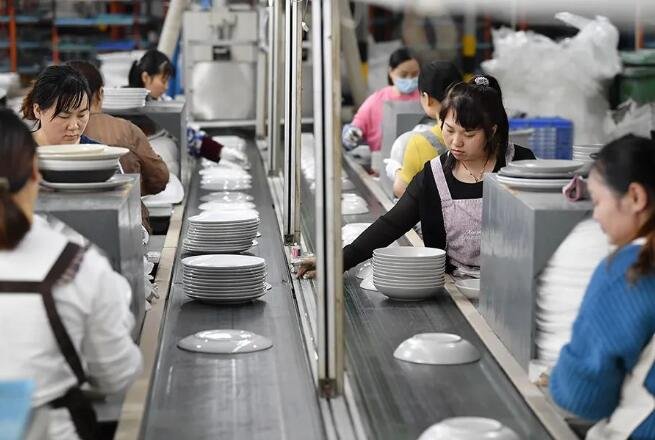
The queue in front of the line is what no quotation shows. MugFactory runs ceramic, bone china and stoneware on exclusive Liling lines, with six production bases, ten branch factories and twenty kilns behind them. Capacity is large but sequenced, so a program arriving behind a seasonal block waits. Mixed designs can share one run — our MOQ guide explains how.
Approved artwork, a signed sample and the deposit put an order into that queue. Cost follows: indicative tier pricing for standard 11 oz mugs starts at $2.50 at 500 pieces, $2.20 at 3,000 and $2.00 at 10,000, FOB Liling, with the current tiers on our pricing page.
4. Freight: about 30 days by sea
At a glance: sea freight from China to the US or Europe is about 30 days port to port, with clearance and inland transport outside that figure.
Sea is the default for mugs because volume to value is high: a 20GP holds about 28 CBM, a 40GP about 58 CBM and a 40HQ about 68–76 CBM, so packing efficiency can mean one container rather than two.
Transit varies by coast and season — typically 25–35 days to the US west coast, 30–40 days to the US east coast or Europe — so about 30 days is a planning figure, not a sailing schedule. Air and express cut transit to days but multiply freight cost.
Delivery terms decide who owns which day. Under Incoterms 2020, the three-letter rule in your quote fixes where risk and cost pass, so read it before counting backwards. Ceramic mugs sit under HTS heading 6912 in the US and the EU, and the rate depends on origin and classification; we do not quote one because we do not set it. Our Cost & Sourcing column covers landed cost.
5. Where timelines slip
At a glance: late launches usually trace to artwork changes, a late sample approval, a peak-season booking or missing documents.
| Stage | What delays it | Control |
|---|---|---|
| Artwork | Files rebuilt after approval, colour references changed | Approve one version and freeze it |
| Sampling | Slow feedback, or the sample round trip | Agree a checklist and an approval date |
| Capacity | Order placed inside the August–November peak | Book the line before the season opens |
| Production | Mid-run artwork or packaging changes | Freeze the specification at sample approval |
| Freight | Missing documents, or a late sailing booking | Send documents early, confirm the sailing |
A rush works only when the line has room and the documents are ready. Rush production is a separate line item that compresses production, not sampling or the sea crossing. If the date cannot hold 30–45 days plus about 30 days at sea, the honest options are a later shelf date, air freight, or a simpler decoration.
Ask for the calendar with the price: name the shelf date in the quote request and ask for the production start, ex-works date and sailing window in writing.
6. Working backwards from a shelf date
At a glance: start from the day goods must be in your warehouse, subtract freight, production and sampling, and the order date lands weeks earlier than most buyers expect.
Take a 1 December retail launch. Goods must reach the warehouse by 20 November to leave a week for intake and a week of slack. Sea freight of about 30 days means the container should sail around mid-October; a 30–45 day run puts approval around 10 September, sample approval in late August, artwork approval in mid-August and the brief in late July. The figures are indicative; the shape of the calculation is not.
| Shelf date | Production must start by | Sample approved by | Artwork approved by |
|---|---|---|---|
| 1 December | 10 September | Late August | Mid-August |
| 1 November | 10 August | Early August | Late July |
| 15 January | 20 October | Mid-October | Early October |
An autumn shelf date is hardest, because production lands inside the peak window. Our holiday production calendar repeats the calculation for every on-shelf date, including weeks already committed; use it as a planning grid and confirm dates in your quote.
7. How MugFactory de-risks the calendar
MugFactory is a vertical full-stack custom mug company: design, packaging, QA, export documents and after-sales sit with one in-house team on exclusive Liling lines that have produced ceramic mugs for export since 1994.
- A digital mockup within one hour of a complete brief, so artwork problems surface before a sample is scheduled.
- Samples in 7–10 days after artwork approval, checked against the approved Pantone reference with a colour meter.
- Three-stage quality control, from pre-production assessment to in-process colour and kiln records, a drop test and a photo QC report.
- Production at 30–45 days after approval, with the August–November peak flagged at quote stage and export documents coordinated in house.
Planning a custom mug program?
Send the shelf date, the quantity and the decoration. We will come back with a production schedule that starts from your calendar, not ours.
FAQ
How long does a custom mug order take end to end?
For a standard 11 oz mug with one decoration and sea freight, plan about ten weeks from artwork approval to arrival: 7–10 days of sampling, 30–45 days of production and about 30 days at sea, plus your approval time and clearance.
What is the fastest realistic timeline?
Compression comes from removing revisions and overlapping steps, not from asking the factory to hurry. Approve the mockup early, approve the sample by photograph and choose air freight. Production still needs 30–45 days on a standard body, and rush surcharges are quoted separately.
How much does peak season add?
August to November is when capacity fills first, so a program arriving without a booked line waits for the next slot. We will not put a number of weeks on it, because the wait depends on product and queue. Brief and approve before August for holiday delivery.
Can you rush an order?
Sometimes, when the line has capacity and the artwork is final. Rush production is quoted against the specific schedule and shortens production, not sampling or sea freight. If the date is impossible, air freight for part of the order or a simpler decoration is better than a promise.
What causes most delays?
Artwork changes after approval, a sample approved later than planned, an order placed inside peak season and incomplete export documents. Each adds calendar days before the factory can act. A frozen specification and a written approval date remove most of the risk.
Sources

MugFactory’s sourcing and production team helps brands, retailers and distributors plan custom ceramic mug programs from 500-piece pilots to annual production. Based in Liling, close to the lines, the team covers design, packaging, QA, export documents and after-sales.


