

Most souvenir mug advice starts with the artwork: choose a landmark, add a skyline, print it in two colours. That is the last decision, not the first. A city or national-park series is a retail product with a shelf date, a price point and a licensing file. Travel souvenir mugs wholesale only work when body, print and pack survive a till, a suitcase and a dishwasher.
This guide is for souvenir retailers, attraction buyers and destination brands building a range rather than a one-off. It covers how many designs a season carries, which body and decoration suit which destination, how quantities work across a multi-design run, and how to work back from a shelf date. It belongs with our Branding and Presentation column.
Key takeaways
- A series is a range, not a design: four to six mugs sharing one body and palette outsell six unrelated SKUs.
- 500 pieces per design is the standard MOQ, and mixed designs share a production run.
- Work back 75–90 days from arrival: 7–10 days sampling, 30–45 days production, about 30 days at sea.
- Peak capacity fills from August to November, so a Christmas series is locked before summer.
- Protect the destination: written permission for every mark, and a master sample approved in the final colour.
1. A souvenir mug is a retail product, not a printed blank
At a glance: the shelf, the price point and the season decide the mug, and the artwork is the last thing to fix.
A visitor buys a mug because it is the cheapest way to carry a place home. That makes it a memory object, not a drink container: the design must read at three metres on a crowded shelf, the handle must look comfortable in a photograph, and the pack must survive a suitcase.
Price architecture decides more than taste. At an indicative $2.20 per mug on a 3,000-piece run, a seasonal series can afford a printed sleeve or a pulp gift box; at 500 pieces the same box eats the margin. Fix the retail price and pack format together, then let the body follow. Our travel souvenir mug range is built around that order.
2. Design the range before the single mug
At a glance: a series needs shared structure — one body, one base glaze, one logo position — so six designs read as one family.
The usual failure is six designs that share nothing: different bodies, palettes and handles, bought separately over a year. Each may be a fine mug, but they compete for the same shelf and none builds a collection.
A workable architecture is one hero design that carries the destination, three or four core designs on the same body and accent colour, and one or two seasonal designs that change annually. Collectability comes from the shared frame: a visitor who bought last year’s mug should recognise this year’s as the same family. That is how a national park series works across visitor centres. The nation-themed range shows how destination themes are grouped before a new shape is tooled.
3. Match the body and decoration to the destination
At a glance: the destination type predicts body weight, print method and how much care the mug will get at home.
| Series type | Body | Decoration | Why it works |
|---|---|---|---|
| Heritage city | 11 oz / 330 ml ceramic | Two-position decal, matt glaze | Skyline and type read at shelf distance |
| National park | 15 oz / 450 ml stoneware | Full-wrap decal or relief band | Weight suits outdoor and lodge retail |
| Coastal and outdoor | 11 oz / 330 ml ceramic | Screen print in one or two colours | Bold mark survives sand and rucksacks |
| Museum and gallery | 11 oz / 330 ml porcelain | Full-wrap decal, gloss glaze | Dense white body shows fine artwork |
| Premium gift | 8 oz / 240 ml bone china | Decal with gold rim | Gift box and hand-wash care label |
A decal is the workhorse: full colour, fired into the glaze, able to hold a skyline, a contour map or a line of type. Screen printing suits a bold single-colour mark on a large run. Sublimation reproduces photographs but needs a coated body, so care instructions must be explicit. A gold rim signals premium and normally means hand wash and no microwave, so it belongs on the pack.
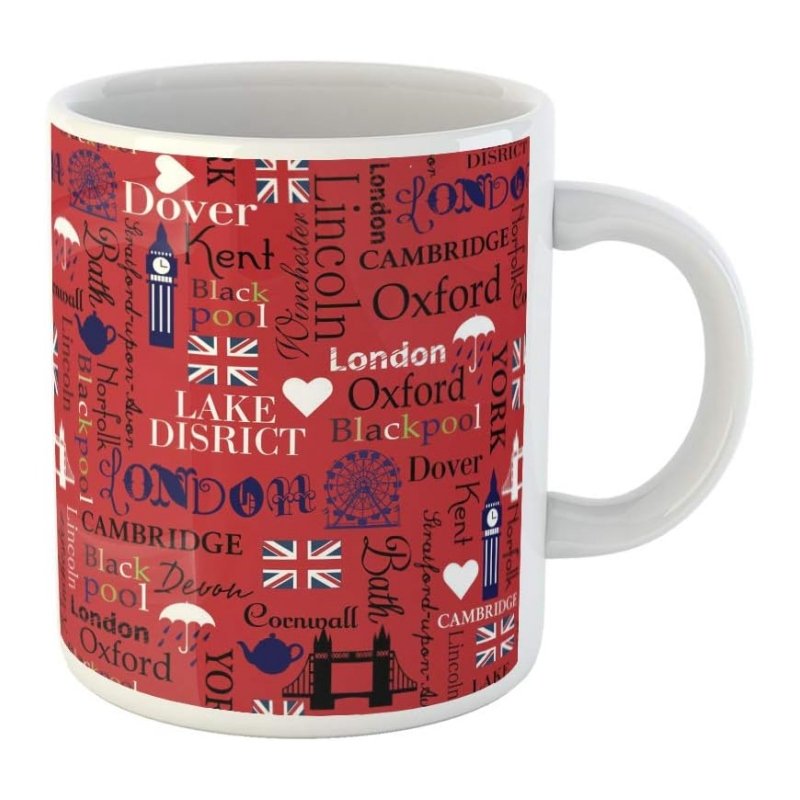
Handling matters as much as looks. A coastal series is bought wet and washed in a dishwasher; a museum series is bought dry and kept on a shelf. If the label says dishwasher safe, confirm the decoration and firing combination in writing. Two ranges we produce often, UK travel-themed ceramic mugs and American travel-themed ceramic mugs, are usually an 11 oz / 330 ml body with a full-wrap print.
4. Quantities, mixed designs and what a series costs
At a glance: standard bodies start at 500 pieces per design, mixed designs can share a run, and sample orders can sit below MOQ.
| Program type | Quantity shape | Margin logic | Packaging need |
|---|---|---|---|
| Attraction gift shop | One hero design from 500 pieces | Margin from exclusivity, not volume | Display tray and branded sleeve |
| City visitor centre | Three to five designs at 500+ each | Range breadth lifts basket size | Compact pack-out, bag option |
| National park retail | Seasonal volume from 3,000 | Volume tier funds a gift box | Drop-tested carton, pulp insert |
| Supermarket souvenir aisle | 10,000+ across the range | Lowest unit cost, fixed retail price | Shelf-ready tray, barcode, carton marking |
| Online-only store | Short run from 500 pieces | Margin has to absorb returns | Parcel-grade pack with drop test |
Indicative travel souvenir mugs wholesale pricing moves from $2.50 at 500 pieces to $2.20 at 3,000 and $2.00 at 10,000, FOB Liling, including one-position printing and standard export packaging. The tier is the first lever a buyer pulls, and it is why a six-design series is often consolidated into one run.
Mixed designs share a run but not a setup: each design carries its own decal or screen cost, so model a per-design fixed cost plus a per-unit price. A supermarket program with a shelf-ready tray and a barcode carries retail pack costs a visitor centre does not; our retail and supermarket mug range covers it. Send the design count and per-design quantities with your quote request.
5. Seasonality: work back from the shelf date
At a glance: a souvenir series is a calendar problem, and artwork approval lands roughly 100 days before the shelf date.
| Season | On shelf | Approve artwork by | Production window |
|---|---|---|---|
| Spring and Easter | Mid-March | Early December | December to February |
| Summer visitor peak | Late May | Mid-February | March to April |
| Back to school | Early September | Late May | June to July |
| Christmas markets | Mid-November | Early August | August to October |
| Year-round core range | January | Late September | October to November |
The chain is fixed: physical samples take 7–10 days after artwork approval, production takes 30–45 days after sample approval, and sea freight adds about 30 days to the US or Europe, varying by port and season. That is 75–90 days from approval to arrival before store distribution, so a series on shelf in late May needs artwork approved in mid-February.
Peak capacity fills first between August and November, which is exactly when Christmas and half-term programs are produced, so a November shelf date is booked before the summer. Our holiday production calendar works the same arithmetic backwards from each on-shelf date.
If the date has slipped, air freight buys days and costs money; production time does not compress by asking.
6. Protect the artwork and the destination
At a glance: you own the artwork you commission, but the destination name, mark and photography usually belong to someone else.
Artwork ownership is simple when agreed in writing: the client owns the final artwork, and dielines and print files are licensed for that project rather than resold. Destination IP is less simple: a national park, city brand or museum usually licenses its name and marks, and a supplier cannot grant that permission, so get written approval for every mark and keep it with the master sample.
Colour is the other thing to lock. Approve the master sample against a physical reference and agree the tolerance in writing; a ΔE of 1–2 is usually invisible, and it is the difference between a series that matches across three reorders and one that does not.
This article is general information, not legal advice. Confirm the applicable standard with your compliance team or lab.
7. Three routes to shelf, one production run
At a glance: a visitor-centre till, a supermarket shelf and an online listing need three pack formats from the same run.
For travel souvenir mugs wholesale, retail wants a display-ready tray, a barcode and carton marking that survives a distribution centre. A visitor centre wants a smaller pack-out and often a bag rather than a box. An online seller wants a pack that survives a parcel network and photographs well on arrival. All three come from one run if the formats are agreed before packaging artwork is approved.
Online is where returns cost lives. A mug that arrives chipped is a replacement plus a review, so the parcel pack needs the same drop test as the retail carton. Our notes on selling ceramic mugs on Amazon and Etsy cover the pack decisions that keep a series profitable after returns.
8. How MugFactory de-risks a city or park series
At a glance: one team owns the body, the print and the export paperwork, so a destination series leaves Liling as one specification.
For a city or national-park series, body choice, artwork approval, sampling and shipping paperwork stay with one team inside MugFactory, alongside design, packaging, QA and export documentation. The company is a vertical full-stack custom mug maker, producing ceramic, bone china and stoneware on exclusive Liling lines since 1994, with six production bases, ten branch factories and twenty kilns behind those lines.
- A body and decoration recommendation for the destination before a price is quoted.
- A free digital mockup within one hour of a complete brief.
- Physical samples in 7–10 days after artwork approval, fee credited against the order.
- Mixed designs on one run from 500 pieces per design, setup visible in the quote.
- Batch traceability, a drop test in the pack, a photo QC report and export documents.
Test the body and the finish first
You have a destination, a shelf date and a design direction. Send those three and we will come back with a body, a print method and the production window that fits the season.
FAQ
What MOQ applies to a city series?
Standard bodies start at 500 pieces per design, and mixed designs can share one production run, so a five-design series can be built from 500 pieces each. Sample orders can sit below the production MOQ. Custom bodies, bone china and large decal programs may require more, which is confirmed in the quote.
How many designs should one season carry?
Four to six is a workable range: one hero design, three or four core designs sharing a body and palette, and one or two seasonal designs. Each design carries its own artwork approval and print setup, so every addition adds fixed cost. Fewer, stronger designs usually outsell unrelated mugs competing for the same metre of shelf.
Can each store receive a different design mix?
Yes, from one production run. Mixed designs can be packed in different ratios per store, with carton marking and an allocation sheet so a distribution centre can split the delivery. Confirm the per-design minimum and packing time in the quote, because a mixed pack-out adds handling.
What lead time do we need for the summer season?
Work back 75–90 days from arrival: 7–10 days for physical samples after artwork approval, 30–45 days of production after sample approval, then about 30 days at sea to the US or Europe. Add store distribution time. For a late May shelf date, approve artwork in mid-February, earlier if the program runs into the peak.
How do we protect the artwork and IP?
Agree ownership in writing: the client owns the final artwork, and dielines are licensed for that project only. Where a destination name, park mark or museum logo is involved, get written permission from the rights holder, since a factory cannot grant it. Keep the approvals with the master sample, and agree a colour tolerance before the first run.
Sources

MugFactory’s sourcing and production team helps brands, retailers and distributors plan custom ceramic mug programs from 500-piece pilots to annual production. Based in Liling, close to the lines, the team covers design, packaging, QA, export documents and after-sales.


