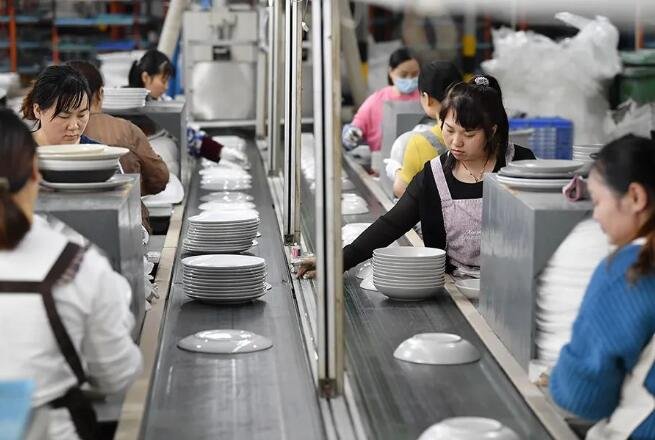
“Ceramic mug manufacturer China” is a search phrase, not a specification. Type it and you get a wall of factory pages that look much the same: a robot arm, a glowing kiln, a certificate on a wall. Almost all describe the process in the order that is easiest to photograph. The order that decides your delivery date starts in a room most tours walk past.
This walkthrough is for buyers who want to understand the plant before committing to a program. By the end you should be able to read a schedule as a chain of approval gates, ask a useful question at each handover, and judge a factory on its sample room and kiln records rather than its forming speed. It is also our own account: we have produced mugs on Liling lines since 1994.
Key takeaways
- The kiln sets the date: production runs 30–45 days after artwork and sample approval, and sea freight adds about 30 days.
- Three quality gates: master-sample approval before production, ΔE and print-position checks during it, a drop test and photo QC report before shipment.
- A decal needs a third fire at roughly 750–850°C so the print fuses into the glaze instead of sitting on the surface.
- Capacity is 100 million pieces a year across six production bases, ten branch factories and twenty kilns.
- About twelve handovers separate clay from carton; most delays come from unapproved artwork or an unsigned sample.
1. Twelve handovers between clay and carton
At a glance: the schedule is a chain of handovers, and any one can hold the order; the forming line is rarely the constraint.
A working plant is not one continuous river of clay. Bodies are prepared in batches, formed, dried, fired, glazed, fired again, decorated, fired a third time, sorted and packed. Every transition is a handover, and at each one the batch can wait — for a drier, a kiln slot, an approved print or a decision from the buyer.
Twelve is a working number, not a fixed count, because plants organise trimming, handle attaching and sorting differently. The pattern holds: material and moisture problems surface in forming and drying, colour problems in glazing and firing, commercial problems in packing and documentation. A schedule that ignores those gates misses its date even when every machine runs flat out.
- Body preparation: clay blended, filtered and pugged to a consistent moisture.
- Forming: the body shaped on a jigger, press or casting bench.
- Handle attaching: joined by hand and checked for alignment.
- Drying: moisture removed at a controlled rate before firing.
- Bisque fire: the glaze-free body fired to strength.
- Glazing: glaze applied by dipping or spraying.
- Glaze fire: the glaze melts and seals the body.
- Decoration: decal, screen print or another process applied.
- Third fire: the decoration fuses into the glaze.
- Inspection and packing: sorting, drop test and photo QC report.
The useful question changes with that list. Instead of asking how fast the line runs, ask which handover your specification makes difficult. A full-wrap print with tight registration demands more kiln attention than a one-colour logo, and a gift box demands more packing time than a standard inner tray. The design decisions behind those constraints are covered in our design and structure articles.
| Step | What happens | Typical failure | QA check | Schedule risk |
|---|---|---|---|---|
| Body preparation | Clay blended, filtered and pugged | Voids, colour variation, cracking | Material verification against the approved body | A body change restarts sampling |
| Forming and handle attaching | Body shaped, handle joined | Wall-thickness drift, misaligned handle | Calipers, handle pull test, visual check | A new shape adds tooling time |
| Bisque and glaze firing | Fired, glazed and fired again | Pinholes, crawling glaze, colour shift | Kiln records, glaze thickness, master-sample comparison | Kiln availability, especially August–November |
| Decoration and third fire | Decal or print applied and fired in | Registration error, colour drift, poor adhesion | ΔE reading, print position, adhesion check | Late artwork and decal supply |
| Final inspection and packing | Dimensions, strength, drop test, packing | Chipped rims, failed drop test, wrong carton | AQL sampling, drop test, photo QC report | Packaging approval and rework |
2. The network behind one mug: six bases, twenty kilns
At a glance: MugFactory runs on Liling lines established in 1994, now six production bases, ten branch factories and twenty kilns with capacity for 100 million pieces a year.
The network is the part a factory video rarely explains. In Liling the supply chain sits next door: clay and glaze materials, decal printers, kiln engineers and a workforce raised around fired clay. That density shortens the loop between a problem and its fix.
For a buyer it matters at three moments. Capacity: twenty kilns across six bases give a scheduler room when one kiln is down. Consistency: the same master sample and glaze standard travel with the order. Documentation: exports to more than 40 countries mean the paperwork your retailer wants has already been handled. The company history and Liling mug factory pages explain the structure.
| Measure | Figure | What it means for a buyer |
|---|---|---|
| Established | 1994 | Three decades of export production behind the lines |
| Production bases | 6 | Capacity balanced across sites |
| Branch factories | 10 | Specialised steps stay inside the network |
| Kilns | 20 | Firing scheduled, not queued behind one kiln |
| Annual capacity | 100 million pieces | Pilot runs and volume programs share one standard |
| Export markets | 40+ countries | Documentation experience for different destinations |
3. Forming, drying and the first fire
At a glance: forming sets wall thickness, handle position and nominal capacity; drying and the first fire decide whether those dimensions survive to the glaze.
Round bodies are usually jiggered or pressed, complex shapes and relief need a mould, and handles are joined by hand. The choice is a tooling decision as much as a design one, which is why a new shape adds sample time before production time.
Wall thickness is the quiet variable. A thin wall chips at the rim and loses heat; a thick wall makes the mug heavy in the hand and the carton. Capacity is measured after firing because the body shrinks, so a millilitre specification has to be checked on a fired sample rather than a drawing. Our mug shapes and sizes guide takes that further.
Firing temperatures follow the body. Earthenware typically fires around 1000–1150°C, stoneware around 1180–1280°C and porcelain around 1300–1400°C. A higher fire gives a denser, whiter body but narrows the window for decoration, which is why a material change is never just a price line. The same applies to ceramic mugs in a standard body.

4. Glazing: the surface the print will sit on
At a glance: glaze is not a cosmetic layer; it seals the body, carries the colour and decides how a decal bonds in the third fire.
Glaze is applied by dipping or spraying, and thickness has to be even across wall, rim and handle. A thin patch shows as a dull spot; a thick pool can crawl and leave a bare patch that fails inspection. The glaze fire also fixes final dimensions, so the mug measured after this stage is the mug your customer receives.
Matte and gloss finishes are decided here too. Matte scatters light and softens print contrast; gloss gives a brighter image and wipes clean. A colour-inside program adds a second glaze operation and a stricter rim check, because two glazes meet at the lip.
5. Decoration: from one colour to full-wrap eight
At a glance: decoration follows the artwork, the care instructions and the volume, not the machine a factory prefers to keep busy.
The workhorses are decal, screen print and sublimation. A decal is printed on a transfer film, applied to the glazed mug and fired in; it handles complex artwork and strong coverage, which is why it dominates B2B programs from 500 pieces upward. Screen printing lays down one colour per screen and suits bold spot colours. Sublimation transfers dye into a polymer-coated body at around 180–200°C for 60–180 seconds; it reproduces photographs well, but coating and care claim must be specified together.
Relief and embossing are mould decisions, so they belong in the tooling conversation before artwork is finalised. Gold rims signal gifting but are hand wash only and never microwave safe, and the care label must say so. Laser engraving marks the glaze permanently for a tonal, low-contrast logo.
Print capability runs from one colour to full-wrap eight-colour decoration. The jump is not linear in cost or risk: registration, colour matching and kiln time all rise, and a full wrap makes handle position part of the artwork. Our customisation options set out the combinations we quote most.
6. The third fire: why a decal needs 750–850°C
At a glance: a decal is not a sticker; it is fired into the glaze at roughly 750–850°C, which makes the print part of the mug rather than a layer on top of it.
The third fire is the step most buyers never see and most delivery dates quietly depend on. Ceramic pigments are printed onto a transfer, applied to the glazed body and fired so the decoration fuses with the glaze. Done correctly, the print sits in the surface and survives washing. Done badly, it looks fine in the sample room and fails in a dishwasher.
The band is roughly 750–850°C depending on pigment and glaze; outside it, colours shift, decals blister or adhesion drops. Kiln records are kept per batch, and a colour approved from a photograph is not approved at all. Our QC team reads the fired print with a colorimeter, records ΔE against the master sample and logs print position for the batch. A ΔE of 1–2 is usually indistinguishable by eye.

7. Final inspection: drop tests, handles and the photo QC report
At a glance: final inspection tests the mug as the customer will use it and documents the batch before it leaves.
The final stage covers dimensions and appearance, handle strength, a drop test in the packed carton, dishwasher and microwave checks where the claim allows, food-contact documentation and a packaging check against the approved dieline.
AQL sampling is standard in consumer goods, commonly at AQL 1.0 or 2.5 with critical, major and minor defects defined by the buyer. The definitions matter more than the number: a pinhole inside the mug and a chipped rim should not share a category. Glaze and decoration are tested to FDA and LFGB requirements, and reports are available on request; the applicable standard depends on the market.
Before shipment the batch is photographed and a photo QC report is issued, with batch traceability records kept for the run. For a buyer on another continent, that report is the difference between hoping the carton is right and knowing it. The same discipline is set out on our Why MugFactory page.
8. Lead time: where the calendar actually goes
At a glance: the clock starts at artwork approval, pauses for the physical sample, then runs 30–45 days of production and about 30 days at sea.
Artwork approval is the first gate. A complete brief earns a free digital mockup within one hour, and the physical sample follows in 7–10 days after artwork approval. Sample fees are credited against the production order, which makes sampling cheap next to a wrong production run.
Production then takes 30–45 days after both approvals. Peak season from August to November fills capacity first, so a holiday program has to lock its slot earlier than its production window suggests. Sea freight adds about 30 days to the US or Europe and varies by port and season; air and express are faster and dearer.
In-stock programs are a separate case: bulk goods of around 10,000 pieces can ship within 45 days where stock is available. For made-to-order work, build the calendar backwards from the on-shelf date and treat every approval as a gate. Send the brief through our quote request and ask for the calendar with the price.
| Stage | Typical duration | Clock starts when | What can extend it |
|---|---|---|---|
| Digital mockup | Within 1 hour of a complete brief | Brief received | Missing artwork or packaging decisions |
| Physical sample | 7–10 days | Artwork approved | Decal supply, new-shape tooling, sample shipping |
| Production | 30–45 days | Artwork and sample approved | Peak season, glaze rework, packaging delay |
| Sea freight | About 30 days | Goods leave Liling | Port congestion, route and season |
| In-stock shipment | Around 45 days for about 10,000 pieces | Order confirmed | Stock availability and carton marking |
How MugFactory de-risks the production calendar
MugFactory is a vertical full-stack custom mug company. We produce ceramic, bone china and stoneware mugs on exclusive Liling lines, and manage design, packaging, QA, export documents and after-sales with one in-house team. The difference is fewer handovers between companies and one team accountable when a batch needs rework.
- Artwork and technical assessment before sampling, so capacity, decoration and packing are agreed before tooling or a decal is committed.
- Master-sample approval as a production gate: the line is scheduled only after the sample is signed off.
- In-production checks on forming, glazing, printing and firing, with ΔE readings, print position and kiln records logged per batch.
- Final inspection with a drop test and a photo QC report before shipment, backed by batch traceability records.
- FDA/LFGB test reports and BSCI, Sedex, FSC, Higg FEM and ISO 22000 documents available on request for retailer onboarding.
See the line your order will run on
You have followed the mug from clay to carton. To see the sample room, the glazing line and the kilns before you book capacity, send your brief and travel window.
FAQ
How long does it actually take to make one mug?
One mug moves through the plant in days rather than minutes: forming, drying, two or three fires, decoration and inspection. The commercial answer is 30–45 days of production after artwork and sample approval, plus 7–10 days for the physical sample and about 30 days at sea.
What is a third fire and why does decal need it?
A decal is printed on a transfer film, applied to a glazed mug and fired at roughly 750–850°C so the decoration fuses into the glaze. Without that fire the print would sit on the surface and wear away. The third fire is also where colour drift and registration problems show up.
Can buyers visit the Liling factory?
Yes, by arrangement. A visit usually covers the sample room, forming and glazing, the kiln floor, final inspection and packing, and it is the fastest way to see how a batch is checked. Send your brief and travel dates first so the team can match the visit to your order.
What is your annual capacity?
Capacity is 100 million pieces a year across six production bases, ten branch factories and twenty kilns. That volume is shared between pilot runs and annual programs. Peak season from August to November fills first, so confirm your slot when you approve the sample rather than when you order.
Why is the factory in Liling?
Liling concentrates the skills a mug needs: clay and glaze suppliers, decal printers, kiln engineers and workers who have spent their careers in ceramics. Keeping production there means the sample room, the kilns and the decoration suppliers sit close together, so rework or a colour correction stays inside the network.
Do you provide food-contact test reports?
Glaze and decoration are tested to FDA and LFGB food-contact requirements, and reports are available on request. Which standard applies depends on the destination market and the product, so confirm the requirement with your compliance team. We can also provide BSCI, Sedex, FSC, Higg FEM and ISO 22000 documents for retailer onboarding.
Sources

MugFactory’s sourcing and production team helps brands, retailers and distributors plan custom ceramic mug programs from 500-piece pilots to annual production. Based in Liling, close to the lines, the team covers design, packaging, QA, export documents and after-sales.