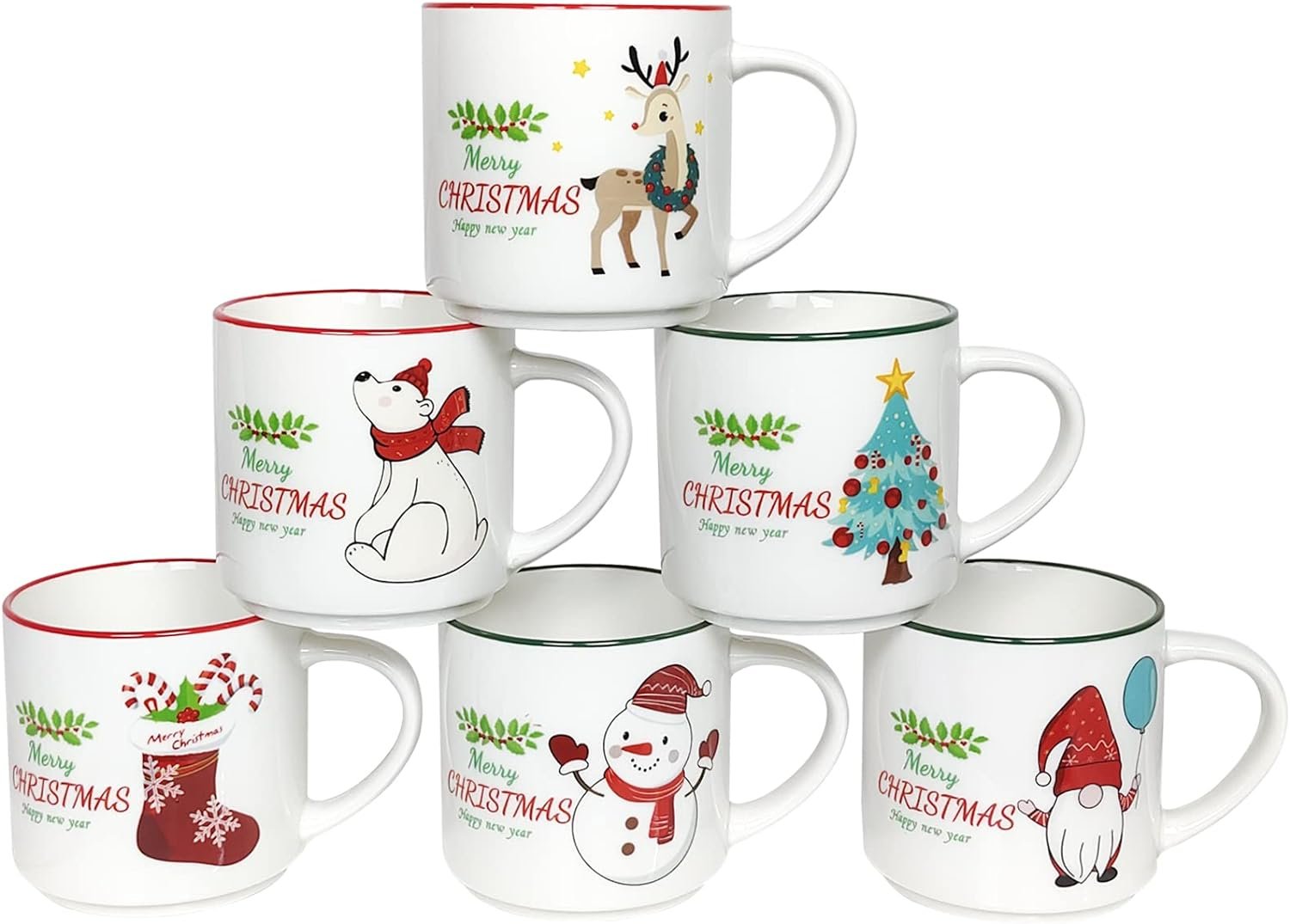

Most buying advice for a custom mug gift box starts with a catalogue of styles — rigid, folding, magnetic, kraft with a window — and then a print finish. That order is backwards. The box that breaks a launch is rarely badly made; it is well made for the wrong retail scenario, with an insert that lets the handle travel, a carton that eats container cube, or a barcode printed across a fold.
This guide is for brand owners, retail buyers and distributors specifying packaging for a gift or retail SKU. By the end you should be able to choose a box configuration from the retail scenario rather than a sample photo, calculate what that choice does to carton cube and freight, and write an insert and drop-test specification the factory can pack to.
Key takeaways
- Scenario before style: shelf retail, e-commerce parcels and corporate gifting need three different configurations for the same 11 oz / 330 ml body.
- Cube is a cost line: if a box adds 40% packed volume per mug, per-mug sea freight rises by about 40% while the container stays volume-limited.
- The insert protects the handle: pulp, corrugated, foam and fibre fail in different ways, so choose for the failure you cannot accept.
- Drop-test the packed carton: final inspection includes a drop test and a photo QC report before shipment.
- 500 pcs is the standard MOQ and production runs 30–45 days after approvals, so a custom box belongs at quote stage.
1. Start with the retail scenario, not the box
At a glance: the box is decided by where the mug is sold and how it travels to the buyer, not by which finish photographs best in a mockup.
Three scenarios cover most programs. A supermarket listing needs a printed carton with a barcode, a window or a photograph, and a case pack the retailer accepts. A web store sends single units through a parcel network, so the box must survive a drop at the door without a second outer. Corporate gifting is judged at the moment of opening: a rigid box, a sleeve, a ribbon, and a pallet delivery to an office rather than a shelf.
The same 11 oz / 330 ml body serves all three; only what the buyer pays for changes. Our ceramic mugs range covers the standard bodies that fit common inserts without a new mould, and the mug gift sets range shows how two mugs are packed as one retail unit.
| Configuration | Cost tier vs standard pack | Packed cube per mug | Retail fit | Typical program |
|---|---|---|---|---|
| Standard tray + export carton | Base | Lowest | Wholesale handling only | Distributor and café volume |
| Printed folding carton | Low | Low | Shelf-ready print and barcode | Retail and e-commerce |
| Corrugated fitment + sleeve | Low–mid | Low–mid | Product visible through a sleeve | Gift and grocery |
| Rigid box with foam insert | High | High | Premium unboxing, no shelf hook | Corporate gifting |
| Rigid two-piece with magnet | Highest | Highest | Luxury presentation, assembly-heavy | Limited editions and weddings |
2. Price the cube before you choose the finish
At a glance: a custom mug gift box that adds 40% to packed volume per mug adds roughly 40% to per-mug sea freight while the container is filled by volume.
Mug programs are often volume-limited rather than weight-limited, because a pallet of boxed mugs runs out of container space before it runs out of payload. A 20GP holds about 28 CBM, a 40GP about 58 CBM and a 40HQ about 68–76 CBM. Pieces per container is container volume divided by packed volume per mug; freight per mug is the container rate divided by that piece count.
Illustrative assumption: if a standard pack takes 1 unit of cube per mug and a rigid gift box takes 1.4, pieces per container fall by about 29% (1 ÷ 1.4 = 0.71) and per-mug freight rises by about 40% at the same rate. Confirm whether the price is FOB Liling or EXW under Incoterms 2020, and send packed dimensions when you request a quote so packaging cost sits beside the mug price. Duties and taxes sit outside the FOB price, and ceramic mugs fall under tariff chapter 6912 in the US and EU schedules, with the rate confirmed by your broker.
3. Choose an insert for the failure you cannot accept
At a glance: the insert is the cheapest component in the pack and the one that decides whether a handle arrives intact.
Breakage in transit usually has four causes: the mug moving inside the box, the handle taking the impact of a dropped corner, the rim rubbing against a hard surface, and the decoration abrading against board. A moulded pulp tray separates bodies and holds the base; a die-cut corrugated fitment locates rim and handle; foam encapsulates the body at a cost in cube and material; and tissue in a bag protects nothing structural.
Measure the approved, fired sample rather than a drawing, because clay shrinks and a handle is pulled by hand. Our mug capacity chart keeps the box label, the product page and the fill line consistent.
Lidded bodies need a different logic: the lid is a second component that can separate in transit, and a commuter mug also has a seal to protect. Our with lid mugs range shows the shapes that need a fit check and a leak test alongside the drop test.

| Insert | Protects best | Weak point | Tooling | Best for |
|---|---|---|---|---|
| Moulded pulp tray | Base and body separation | Handle exposed at some angles | Mould per body size | Distributor and café volume |
| Corrugated fitment | Rim and base location | Handle abrasion if loose | Cutting die per box | Retail cartons at volume |
| EVA or PE foam | Full body encapsulation | Cost, cube, recycling routes | Cut or moulded insert | Rigid gift boxes |
| Moulded fibre or honeycomb | Handle and rim without plastic | Slow to pack consistently | Low tooling | Plastic-free programs |
| Platform with ribbon or tag | Presentation and rim support | A tight ribbon can chip a rim | Assembly labour | Wedding and corporate gifts |
4. Set the drop test and the accept-or-reject rule
At a glance: test the packed carton, not the bare mug; a body that survives a drop alone can still arrive broken inside a box that lets it move.
Write the test into the specification before the master sample is approved. Name the configuration under test, the drop orientations, the height agreed with your lab or the retailer’s standard, and what counts as a failure: a cracked body, a chipped rim, a loose handle, a failed lid seal or a box that opens.
Inspection sampling usually runs to an AQL level agreed with the buyer, with critical, major and minor defects defined in the same document; AQL 1.0 and 2.5 are common reference points, but definitions matter more than the number. Batch traceability and a photo QC report turn a damage claim into a conversation about one identified batch. Our design and structure column covers the body decisions that come first.
| Configuration | Likely failure | Test scope | Pass criteria to agree | Fix if it fails |
|---|---|---|---|---|
| Standard tray + carton | Handle crack on the dropped corner | Carton drop, all faces and one edge | No cracked body or loose handle | Corner pads or heavier board |
| Printed carton, single unit | Rim chip through the carton wall | Single-parcel drop | No chip, print intact | Internal tray or higher board grade |
| Rigid box with foam | Box corner crush, foam tear | Drop and vibration | Mug intact, light scuffing acceptable | Shipping outer or corner protectors |
| Two-mug gift set | Body-to-body contact | Drop and incline | No contact marks or chips | Divider or platform between mugs |
| Lidded or commuter mug | Lid separation, seal leak | Drop and leak check | Seal holds, lid stays seated | Insert redesigned around the lid |
5. Make the carton retail-ready and keep claims provable
At a glance: a retail box needs a barcode, origin, material and care wording, and only claims you can document; settle all four before the print run.
Barcode artwork belongs in the dieline rather than on a sticker applied later: keep the quiet zone clear, avoid a fold through the symbol, and confirm the number with the retailer. Country of origin, material, capacity and care instructions are usually required too. A gold rim is hand wash and not microwave-safe, so the care line is part of the specification.
Material claims carry more risk than buyers expect. FSC-certified board can be used for colour boxes and inner trays, but the label has rules about licence codes and chain of custody, so approve the artwork against the certificate; you can download the FSC certificate for your onboarding file. Recycled content and compostability need third-party evidence; the FTC Green Guides and the UK CMA Green Claims Code treat an unsupported claim as a compliance problem.
- Barcode in the dieline, quiet zone clear, number agreed with the retailer.
- Origin, material, capacity and care wording proofread against the sample.
- Packed carton dimensions and gross weight on the packing list, not only the drawing.
- The retailer’s own packaging specification checked before print approval.
- One named approver, so the print run does not wait on a committee.
6. How MugFactory de-risks packaging
MugFactory keeps packaging inside the same team that runs the mugs: design, packaging, QA and export documentation are in-house on our Liling lines, so the box, the insert and the drop test are specified against the body you are buying, not sourced separately after approval.
- A digital mockup within 1 hour of a complete brief, so box print and mug decoration are reviewed together.
- Print-ready dielines in AI and PDF through the Launch Kit, delivered 3–5 working days after artwork approval.
- Master-sample approval that covers the packed carton, not only the mug.
- A final-stage drop test and a photo QC report before shipment, with batch traceability records.
- FSC documentation and audit documents such as BSCI, Sedex, Higg FEM and ISO 22000 on request.
Get the assets your launch needs
You have the retail scenario, the box configuration and a drop test to agree. The Launch Kit brings the mockup, product photos, spec sheet and print-ready dielines into one approval pack.
FAQ
What is the MOQ for a custom gift box?
A custom mug gift box is quoted with the mug order rather than sold separately, and the standard mug MOQ is 500 pieces per design on standard bodies. A new die or a special board carries a one-off setup, so the per-unit cost falls with quantity. Sample orders can sit below the production minimum — confirm the combination in your quote.
Can we use our own packaging supplier?
It is possible, but confirm it at quote stage, because the box and the mug then come from two suppliers and a breakage claim has two possible causes. If you use your own packaging, send the dieline and board grade early so the insert can be checked against the body, and insist on a drop test of the assembled pack before the run.
Is FSC board available?
Yes. FSC-certified board is used for colour boxes and inner trays, and the certificate is available for your onboarding file. The label has rules: licence code, claim wording and chain-of-custody documentation must match, so approve the artwork against the certificate. Recycled content claims need separate third-party evidence.
How much does packaging add per unit?
Standard packaging — inner tray, carton and export marking — is already inside the indicative tier pricing for standard 11 oz ceramic mugs, from $2.50 at 500 pieces, FOB Liling. A custom gift box is quoted separately. Illustratively, a box costing twice the standard pack adds an amount equal to the standard packaging share, spread over fewer units at 500 pieces than at 3,000.
Can the packaging be retail-ready with barcodes?
Yes. Supply the EAN or UPC number and the label copy at artwork stage, and the barcode is printed in the dieline rather than applied as a sticker. Keep the quiet zone clear and never fold through the symbol. Your retailer’s packaging specification overrides any general template, so check it before print approval.
Sources

MugFactory’s sourcing and production team helps brands, retailers and distributors plan custom ceramic mug programs from 500-piece pilots to annual production. Based in Liling, close to the lines, the team covers design, packaging, QA, export documents and after-sales.